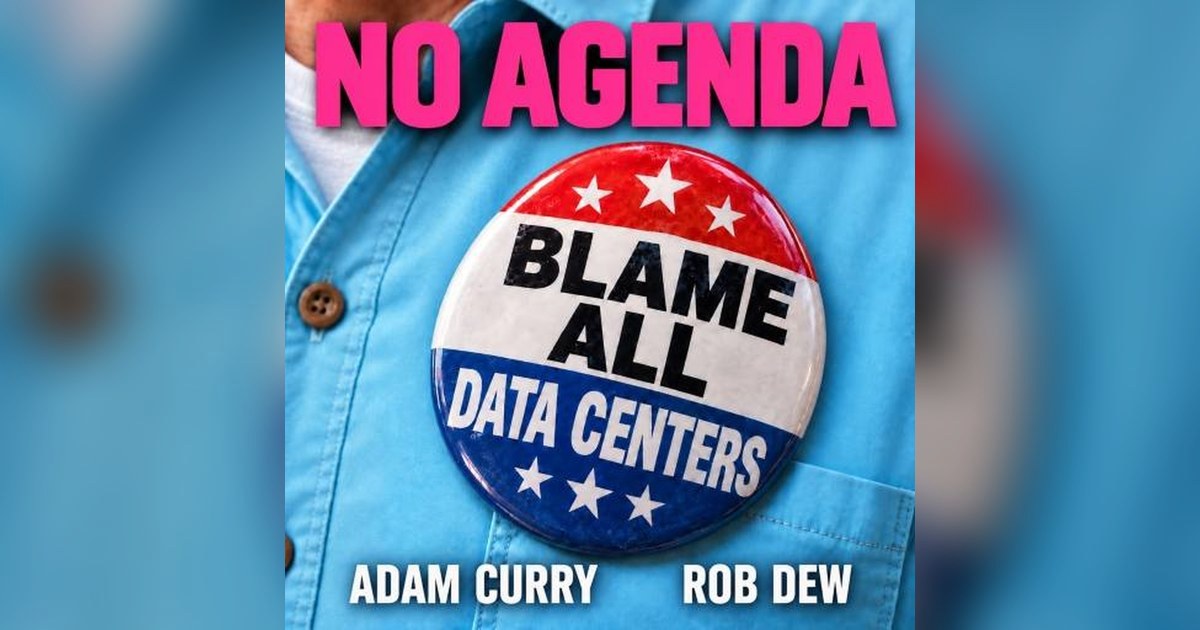
The latest episode of the No Agenda Show, titled "Immune Amnesia," published on October 4, 2026, offers a critical examination of a news cycle that touches on technology, public health, and social upheaval. Host Adam Curry, broadcasting from the Texas Hill Country with guest co-host Rob Dew, navigates a series of stories that reveal underlying tensions in media reporting and societal shifts. The episode's significance lies in its challenge to mainstream narratives, urging listeners to question the framing of events that could have far-reaching implications.
One of the central threads is the accelerating displacement of commercial software by AI agents. Curry and Dew discuss a Gen Z TikToker's warning about AI-driven reverse engineering of banks, satellites, and encrypted systems, which Curry frames as opening Pandora's box. "I'm afraid we've opened Pandora's box, but humanity hasn't even recognized it yet because we've been too excited holding it," Curry says, adding that it has become "the mark of the beast, the birthing pains of the rapture, the second coming of the nuclear bomb. But instead of fission, it's just text." This apocalyptic vision is balanced by Dew's practical experiment: building a donation-spreadsheet tool that replaced Microsoft Excel in his workflow. Curry also introduces his new podcastindexrobot.com MCP server, built on the open Podcast Index he co-owns with Dave Jones, demonstrating how an agent can strip six minutes of dynamically inserted ads from Ed Zitron's Better Offline. The segment pivots to a 1999 David Bowie interview with Jeremy Paxman on the BBC predicting the internet as "an alien life form," highlighting how past visions inform current debates.
The episode also scrutinizes the mysterious FlyDubai Boeing 737 MAX 8 incident, with pilot simulator analysis from Erin Burnett's CNN segment and skepticism over the 20,000-foot dive narrative. This focus on aviation safety and media sensationalism underscores the importance of technical scrutiny in reporting. Additionally, the hosts cover a pneumonic plague death in Russia's Irkutsk region and a measles resurgence in Pennsylvania, featuring NPR's coverage with immunologist Michael Mina and the concept of "immune amnesia." These public health stories illustrate how misinformation and vaccine hesitancy can exacerbate crises, making the episode's deconstruction vital for informed public discourse.
Violent school protests across France, reported by GB News and France 24, are examined, with burning schools, barricades, and "outsiders" in Paris suburbs. The Cornell fraternity allegations, drawing commentary from AOC, Sonny Hostin, and Letitia James, further highlight the intersection of social justice and media framing. The hosts also revisit US Air Flight 427's 1994 rudder hardover, cite Camille Paglia on coeducation, and replay a 1994 Today Show clip of Katie Couric asking "What is internet, anyway?" alongside Gina Raimondo warning of "rioting in the streets" from AI job displacement. By connecting historical events to current ones, the episode emphasizes patterns in media and societal responses.
Overall, No Agenda Episode 1909 matters because it provides an alternative lens on stories that dominate headlines, encouraging listeners to critically assess the forces shaping the news cycle. In an era of rapid technological change and social unrest, such independent analysis is crucial for understanding the implications of AI, public health policies, and media narratives.