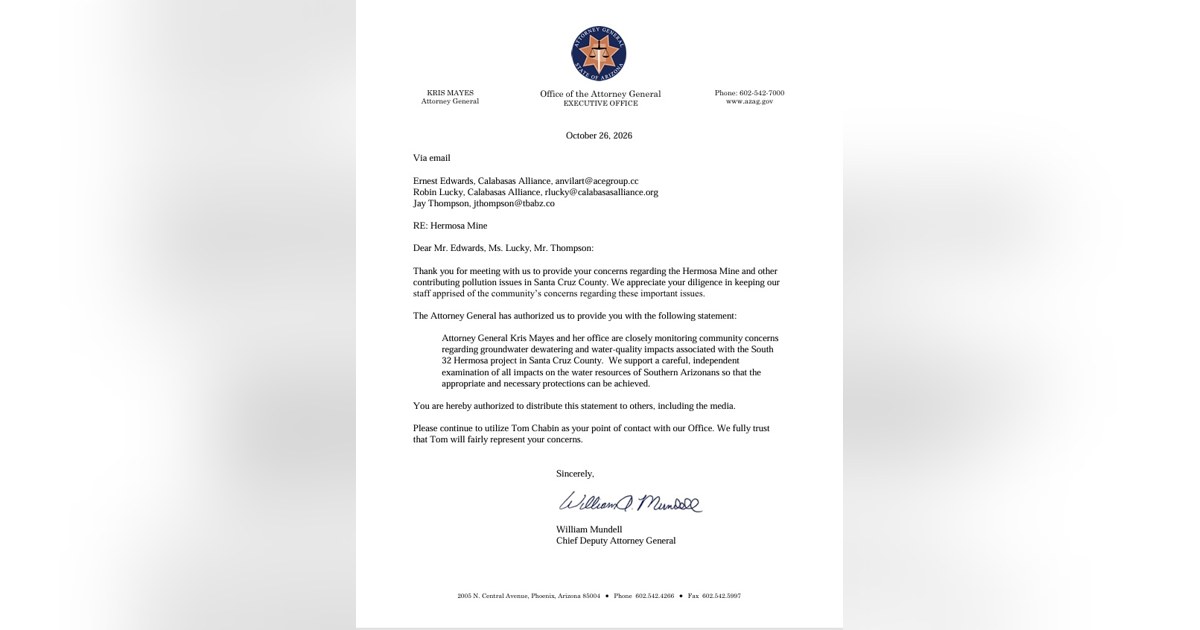
The Office of Arizona Attorney General Kris Mayes has acknowledged community concerns about groundwater dewatering and water-quality impacts tied to the South32 Hermosa Project in Santa Cruz County, according to a statement released by the Calabasas Alliance. The statement, which follows the submission of background information, data, and letters from community members, signals that state-level scrutiny of the mining project's environmental effects is intensifying.
The Attorney General's office said it closely monitors the concerns and supports a careful, independent examination of the project's effects on Southern Arizona's water resources. That endorsement matters because it lends official weight to calls for science that is not funded or controlled by the project sponsor. Community members, technical experts, and researchers have identified gaps in assessing long-term dewatering effects, contaminant pathways, and cumulative impacts on aquifers and surface waters. In response, the Calabasas Alliance is demanding transparent, independently verified science rather than reliance on project-sponsored modeling.
Local leaders warn that high-volume dewatering could create a cone of depression that lowers groundwater levels, threatens wells and surface flows around Patagonia Lake, and necessitates immediate independent hydrologic analysis to secure protections before irreversible damage occurs. The implication is significant: if dewatering proceeds without rigorous outside review, nearby residents and ecosystems could face lasting harm to their water supply. The Attorney General's support for an independent look could prompt regulators to require additional data or conditions before the project advances.
The full announcement, including downloadable images and bios, is available via click here. The Calabasas Alliance, a grassroots organization focused on protecting land, air, and water resources in Santa Cruz County and Southern Arizona, has been building technical capacity to document local conditions. The group participates in the Arizona State University/University of Arizona AirSMART air-quality monitoring program, is a member of the Arizona Department of Environmental Quality Citizen Science Alliance, and recently received a mobile water-testing laboratory through ASU's Water for All program. It also takes part in university forums on PFAS and the Arizona Rural Water Working Group.
The Alliance's involvement underscores why the Attorney General's statement carries weight: it connects community-gathered data with a formal request for independent verification. As the group notes on its Calabasas Alliance website, it collaborates with other organizations across the state seeking similar natural resource protections. With the Attorney General's office now publicly supporting a careful, independent examination, the pressure is on for project proponents to demonstrate that dewatering will not jeopardize wells, surface flows, or public health in Southern Arizona.