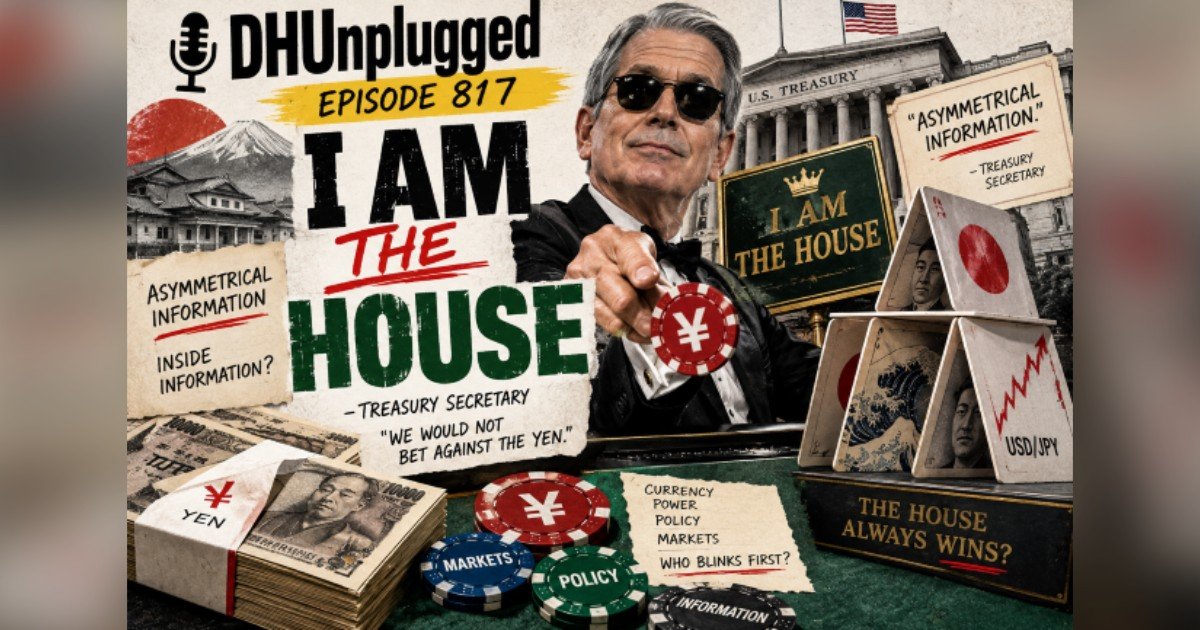
The latest episode of DH Unplugged, titled 'I Am the House,' arrives amid a turbulent week for markets, with the Dow plummeting over 600 points and Treasury Secretary Bessent making headlines for boasting about his insider knowledge of the Japanese yen. Hosts Andrew Horowitz and JC Dvorak dissect the implications of Bessent's remarks, framing them as a stark admission that policymakers now operate as 'the house' in financial markets. The episode, released September 8, 2026, comes just days before a pivotal Consumer Price Index (CPI) report that many strategists view as the ultimate credibility test for the Federal Reserve.
Bessent's comments, which Horowitz recounts, suggest a level of market influence that goes beyond traditional policy tools. 'His way of putting this is, I have an edge. And he even said, because I have the information, I have the inside information about what Japan is doing, therefore when I say something, it's not going to be speculative. It's going to be absolute,' Horowitz says. Dvorak places the admission in historical context, arguing that since 2008, the government has increasingly behaved like the Roman Senate before Caesar, with the Trump era making this dynamic impossible to ignore. This discussion ties into the 'dollar milkshake' conspiracy theory circulating online, which suggests the U.S. is deliberately weakening the dollar to boost exports.
The episode also covers a range of other consequential stories. The Strait of Hormuz remains eerily quiet on AIS trackers, yet Goldman Sachs maintains a $120 per barrel oil target, a scenario that could exacerbate inflationary pressures. Meanwhile, 10-year and 30-year Treasury yields continue to climb against a backdrop of a $40 trillion national debt, raising concerns about fiscal sustainability. Horowitz notes that his firm is buying only short-duration Treasuries, citing the crush of new issuance from Washington and data center operators tapping capital markets globally. This connects to broader market movements, including Bloom Energy's addition to the S&P 500 and sympathy rallies in Oklo and SMR stocks, as well as strength in Intel, AMD, and SK Hynix ahead of Broadcom earnings.
Other topics include Meta's roughly $18 billion multi-state settlement over youth safety guardrails, NVIDIA's reported $13 billion acquisition of Hugging Face—a move JC had called a week early—and Shein's downsized Hong Kong IPO. The hosts also touch on Good Good Golf's Callaway ad backlash, Nike's exit from the S&P 500, Argentina beef imports, a 162,000 payrolls print, and Astra's partial Navier-Stokes proof. Each story is examined through a skeptical lens, with the hosts questioning underlying assumptions and potential market impacts.
The episode's central theme is the growing intersection of government policy and market dynamics. Bessent's yen comments are particularly striking, as they suggest a level of market manipulation that was once unthinkable. Dvorak argues that this is part of a longer trend, where the government has become an active participant in markets, rather than a neutral referee. This shift has profound implications for investors, who must now navigate a landscape where policy decisions are increasingly driven by market considerations.
As the week progresses, all eyes will be on the CPI print, which could set the tone for Federal Reserve policy in the coming months. With oil prices elevated and bond yields rising, the inflation data will be crucial in determining whether the Fed can maintain its current stance or if further tightening is necessary. The hosts suggest that the Fed's credibility is on the line, and the market's reaction to the CPI will be telling.
For investors, the key takeaway from this episode is the need to stay vigilant in an environment where government actions and market forces are increasingly intertwined. The days of predictable policy and market behavior may be over, replaced by a more volatile and uncertain landscape. As Bessent's comments demonstrate, those with inside information have a distinct advantage, leaving ordinary investors to navigate a market where the rules are constantly shifting.