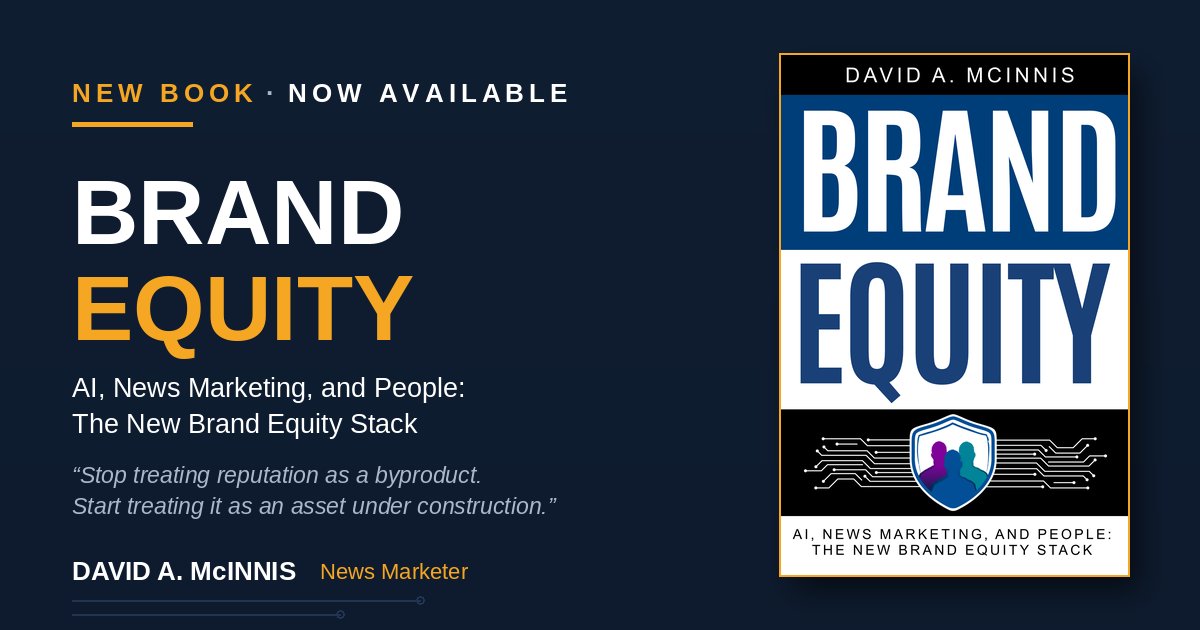
In an era where artificial intelligence increasingly shapes how consumers discover and trust brands, David A. McInnis, the pioneer of News Marketing and founder of PRWeb, has released a new book that redefines brand equity for the digital age. Titled 'Brand Equity: AI, News Marketing, and People: The New Brand Equity Stack,' the book argues that brand equity is no longer solely about what people remember, but also about what retrieval systems can find, trust, and reuse when someone asks a question in your category.
McInnis defines brand equity as the accumulated trust, recognition, and preference that resides in people's minds, translating into commercial advantages like higher prices, faster conversion, and stronger resilience. Historically, this asset seemed reserved for corporations with massive advertising budgets. However, the transformation of distribution, measurement, and discovery has leveled the playing field. Small and mid-sized businesses can now intentionally build and prove brand equity without eight-figure media buys.
The book's central framework, the 'new brand equity stack,' integrates AI, News Marketing, and people. AI accelerates research, drafting, and multi-format content creation, while people and culture ensure the brand remains authentic at every touchpoint. News Marketing serves as the credibility and findability engine in between. McInnis writes, 'AI makes the process faster. News Marketing makes it credible. People make it believable. Measurement makes it honest. Preference is the point of brand equity. Generic sludge does not create preference.'
The link to News Marketing is deliberate. McInnis's previous book, 'News Marketing,' laid the groundwork, and 'Brand Equity' builds upon it. The practice involves putting news on the open web in a structured, timestamped, and entity-clear format, treating press releases as seeds for broader visibility. This approach ensures that customers, journalists, search engines, and AI systems can find and trust the brand's narrative. Laura Sturaitis, retired EVP of Business Wire, praises the series, noting that McInnis has 'literally written the book(s) revealing the tried and true marketing methods and strategies that have delivered for top-tier companies.'
News Marketing accomplishes five critical tasks for brand equity: third-party validation, familiarity through repetition, authority signals, a living public newsroom, and durable retrieval assets that ensure AI systems deliver accurate answers. McInnis succinctly puts it: 'Advertising buys attention. News Marketing banks proof.' The book offers practical sections on the anatomy of brand equity, including awareness, associations, perceived quality, loyalty, and findability. It introduces a monthly Brand Equity Dashboard using free and low-cost signals, along with strategies for pillar development, social proof, consistency, and a comprehensive twelve-month plan.
Three chapters are dedicated to implementing News Marketing: writing and cadencing press releases, transforming one release into an AI-optimized multi-format package, and interpreting modern newswire reporting without falling for fantasy metrics. Importantly, McInnis clarifies what AI cannot do: it will not choose pillars, attend customer calls, decide newsworthiness, or earn third-party validation. Tools amplify strategy, not replace it.
'Brand equity is not magic, not luck, and not the exclusive property of companies with famous logos,' McInnis asserts. 'It is the predictable output of a repeatable process: deliberate visibility, in consistent themes, validated by third parties, structured for retrieval, measured continuously.' This book is a field manual for operators, showing how measurement, AI tools, brand pillars, proof, culture, and a News Marketing cadence turn reputation from a byproduct into an asset under construction.
'Brand Equity' is available as a free download for a limited time and for purchase on Amazon. For media copies, interviews, or speaking inquiries, contact Newsworthy.ai.