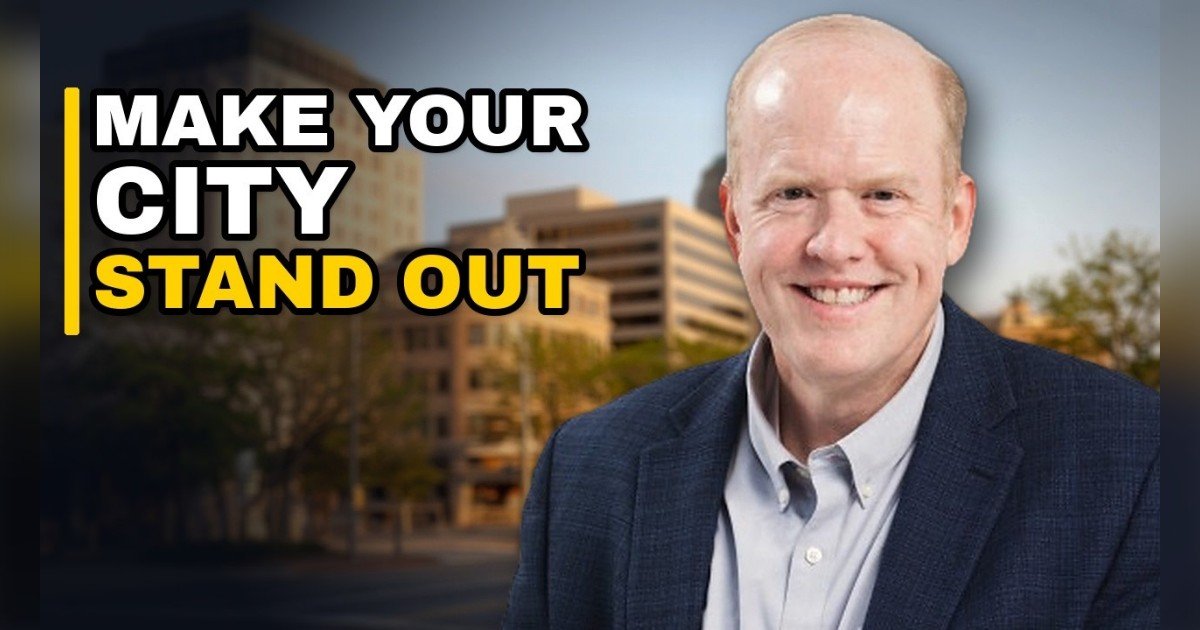
In an era when every city and company pitch can sound indistinguishable, Brandon Fears, Founder and Managing Partner of Gracchus Partners and Chief Growth Officer of idhubs, argues that leaders must identify what he calls a "compelling market edge" to avoid blending into the background. Speaking on the Season 4 premiere and 200th episode of The Building Texas Show with host Justin McKenzie, Fears outlined how a structured approach to public input and a sharper definition of uniqueness can reshape how organizations connect with their audiences.
Fears pointed to vTaiwan, a civic process used during Taiwan's debate over Uber, where participants could post comments and others could only vote thumbs up or thumbs down, rather than engage in heated reply threads. He told McKenzie that this structure "takes heat out of public input," contrasting it with typical city manager meetings that "usually become who's yelling the loudest." Drawing on that model and his work with idhubs, Fears suggested that if city councils adopted software allowing residents to post comments, vote them up or down, and see which concerns were trending, they could improve the local economic environment for businesses by making public feedback more constructive and actionable.
The conversation then shifted to why so many city and company pitches blur together. Fears cited Theodore Levitt's 1960 Harvard Business Review essay "Marketing Myopia" and introduced his own concept of a "compelling market edge," defined as "what's going to make you unique in the marketplace that no other competitor can talk about," together with "what is going to compel a person to buy." He noted that "every city almost sounds the same," with common refrains about great schools, public works, parks, and family-centric living. "Everybody sounds the same, but they're not," he said. When asked what makes San Marcos unique, Fears and McKenzie landed on Texas State University, and Fears offered Prairie View A&M University as another example of a place with a distinct through line associated with perseverance—something leaders need to lean into.
The same problem appears in sales conversations, Fears said. In due diligence work, he will ask four salespeople at one company what business they are in and get four different answers. "I'll tell people, your company is four different companies," he remarked. He also recounted a recent conversation in which an operator treated his toughest competitor as proprietary information, then realized "his best competitor was the customer unwilling to change." Fears told McKenzie it has never been a better time, or a harder time, to be a small or midsize business, with more tools to compete but also inflation, regulation, and larger rivals. The number one problem he sees is owners putting too much money into promotion that is not working, or not promoting at all. His advice includes recording on YouTube, slicing the same material for Facebook, Instagram, and TikTok, considering a cost-effective editor, and not neglecting good audio.
The full episode, Why Every City Sounds the Same - And How to Stand Out, is available on The Building Texas Show's episode page and on YouTube.