Business owners who once relied on noncompete agreements to protect their most valuable asset—their people—are rethinking that approach. The McFarland Group (TMG), an Omaha-based advisory firm for owners of closely held businesses, reports that companies are increasingly turning to well-designed equity compensation to keep and develop key employees.
The shift follows a series of regulatory changes. In 2024, the Federal Trade Commission issued a rule banning most noncompete agreements. A federal court set the rule aside that August, and the FTC dropped its appeals in September 2025. In February 2026, the rule was formally removed from federal regulations. The agency now challenges noncompetes case by case, and a growing number of states have restricted them independently. As a result, owners can no longer count on a signed noncompete to prevent top talent from leaving or taking customers.
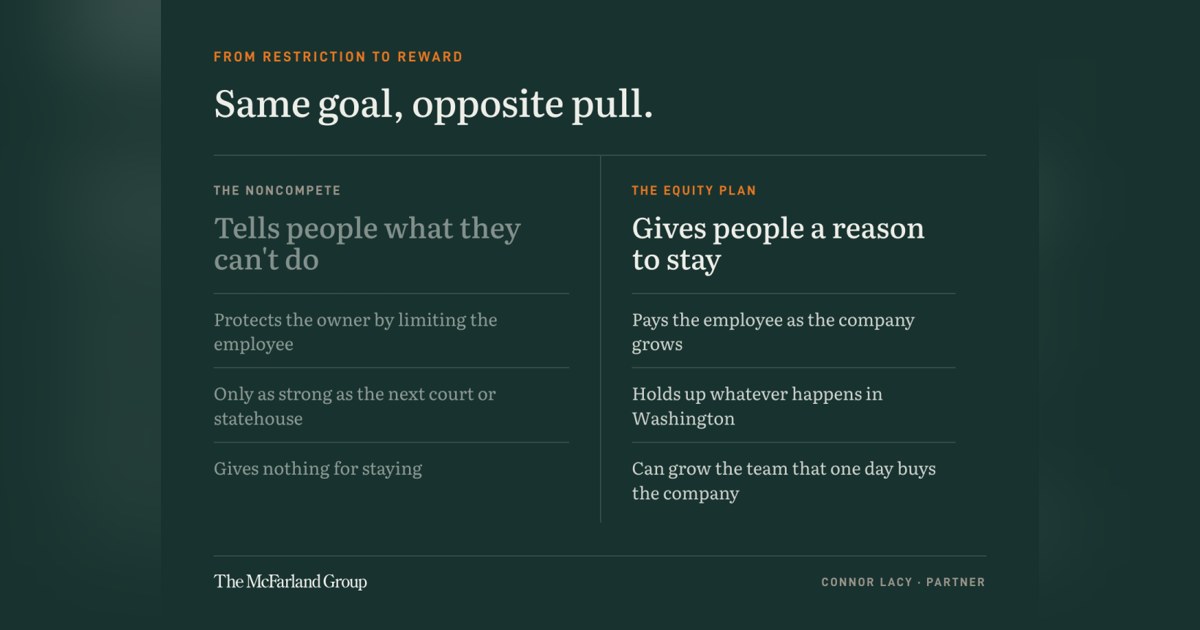
“For years, many owners treated the noncompete as their retention strategy,” said Connor Lacy of The McFarland Group. “But a noncompete only tells an employee what they can’t do. A well-built equity plan gives them a reason to stay.”
TMG is seeing clients redesign incentive plans to accomplish what noncompetes once did. Common approaches include longer vesting schedules that reward employees for staying through key growth periods or an eventual ownership transition; deferred payouts tied to company value, so the largest rewards go to those who help build it; clawback, nonsolicitation, and confidentiality terms paired with equity awards to protect customer relationships and confidential information; and performance-based vesting tied to measurable value drivers such as EBITDA growth and margin.
“The owners getting this right are using equity to build a management team that thinks like owners,” Lacy said. “In many cases, that team can eventually become the buyer.” That potential succession path adds strategic weight to equity plans, turning retention tools into vehicles for ownership transition.
TMG recommends that business owners review existing employment agreements and incentive plans with qualified legal counsel, identify the employees whose departure would most affect company value, and consider whether current compensation gives those people a meaningful stake in the company’s future.
“Regulation will keep changing,” Lacy said. “A retention strategy built on shared value holds up whatever happens in Washington or the statehouse.”
Lacy explores the four plan designs and the concept of building a team that can become the buyer in more detail at themcfarlandgroup.com/blog/noncompetes-equity-plans-next-owners. The firm, founded by Byron McFarland, has guided over $3 billion in business value through more than 200 ownership transitions over two decades and advises on M&A, management buyouts, and performance equity compensation. More information is available at The McFarland Group.