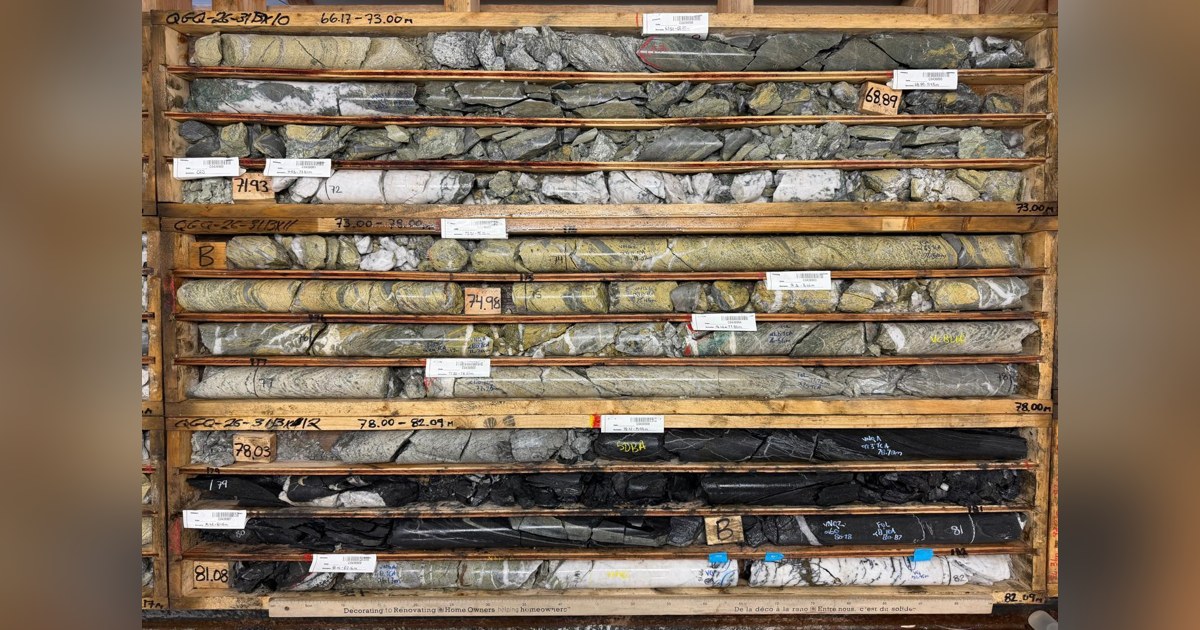
Golden Cariboo Resources Ltd. reported that step-out hole QGQ26-35 at its wholly owned Quesnelle Gold Quartz Mine Property has advanced beyond 416 metres (1,365 feet) while remaining inside the favourable volcanic package that hosts much of the Halo zone mineralization. The significance lies in what the hole has not yet done: it has not intersected the projected western greenstone-argillite contact, the boundary that was expected to mark the edge of the target horizon. That the host rocks persist well past initial projections extends the target horizon considerably and supports continued evaluation of the southern extension of the Halo Deposit beyond the limits of the company's current Mineral Resource Estimate.
The distinction matters for investors because the inaugural MRE set a defined boundary around the deposit. Every metre of favourable host rock encountered outside that boundary is a potential addition to the resource inventory, and QGQ26-35 is testing precisely that ground. The company said drilling, sampling and regional exploration have continued since the MRE was completed. Geological logging is finished on holes QGQ26-31 through QGQ26-34, all drilled after the MRE cut-off date and therefore excluded from the current resource model. Core samples from QGQ26-32 have reached MSA Labs in Prince George for PhotonAssay™ analysis, QGQ26-31 samples were expected to be submitted later in the week, and QGQ26-33 core was anticipated at the lab the following week. Logging of QGQ26-34 and 35 is in progress, with assay results to be released when available.
Surface work is running in parallel. Prospecting and geological mapping are underway north of the Halo zone along newly exposed logging road cuts, targeting possible bedrock sources of anomalous MMI gold-in-soil values. Crews are also mapping and prospecting a parallel trend north of the Km Uno target, described in a Sept.9, 2025 News Release and located roughly two kilometres east of the Halo-Main zone trend, as part of the company's evaluation of multiple prospective corridors across the property.
President and CEO Frank Callaghan said the focus has shifted toward unlocking additional growth opportunities both around the Halo Deposit and elsewhere on the property. He called the progress of QGQ26-35 encouraging, particularly as the favourable host rocks continue beyond 400 metres depth, and noted that field crews are advancing surface targets that could generate future trenching and drill opportunities within the permitted portion of the property. As winter approaches, the company is planning additional step-out drilling to evaluate the southern extension of the Halo Deposit beyond the current MRE and toward the historic Main zone, approximately 700 metres to the southeast. A Click to see map accompanies the disclosure, and further details are available on the Company website.
The technical information was reviewed and approved by Gordon Gibson, a Professional Geoscientist registered with APEGBC and a Qualified Person under NI 43-101. The Quesnelle property covers 96,183 hectares along a 90-kilometre gold trend, with a 789-hectare permitted portion hosting the historic Quesnelle Quartz gold-silver deposit discovered in 1865. The original release is available through www.newmediawire.com.