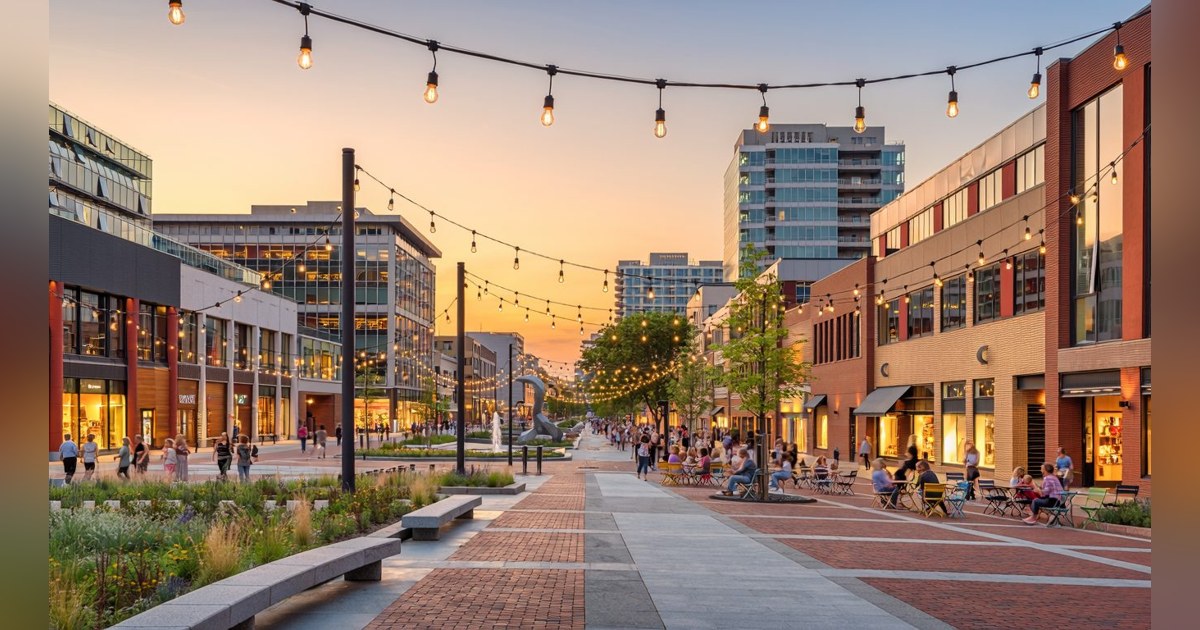
Mixed-use developments often stack apartments, offices or life science space above ground-floor shops, but most people experience a neighborhood from the sidewalk. "The ground floor is where people actually experience a neighborhood. They don't experience the floors above it," said Ann Ehrhart, a Boston retail strategist and founder of EVERSTREET. Identity, she said, is how a place makes you feel—whether you want to stay or simply buy what you came for and leave. Neither is wrong, but many mixed-use business plans count on people staying and lingering, and that kind of identity must be built on purpose.
Ehrhart describes good placemaking as layered, with no single element doing all the work. She starts from the outside in: retail belongs where people can see it and reach it easily, not wherever it fits best next to the lobby and mailroom. From there come blocking and massing, the split between anchors and smaller storefronts, and variety in design and signage. Owners can give tenants their own branded storefronts or work with their design team on storefronts that become the brand. EVERSTREET works through these decisions in the Assess and Plan phases of its Activate Your Street framework.
The space between buildings matters just as much. Ehrhart calls it connective tissue: places to sit, varied planting and paving, public art and lighting. "Never underestimate the power of a few good strands of string lights to really set the tone," she said. Widening and narrowing sidewalks quietly moves people through a space at different speeds. "The best places have elements that are fixed and consistent and elements that are always changing and new," she said. The goal is for none of it to feel forced. "When it's done well, it's invisible," Ehrhart said. "If it's too heavy-handed, it feels manufactured." "Authenticity is everything," she added, especially with discerning, affluent customers who have options—and the tenants a developer wants are typically chasing that same customer.
Leasing storefronts means filling space inside four walls, but programming a place covers the whole experience, including buildings, storefronts and connective tissue. The key, Ehrhart said, is knowing what you're trying to create and what you're starting with. EVERSTREET classifies locations into three corridor types: Destination, where placemaking is often already done because residents, tourists and office workers already go there, so leasing means understanding why they come and filling vacancies to match; Convenience, where people come for what they need and move on, so "a charming little patisserie probably isn't your target for a power center off a highway exit"; and Untested, where there's no proven demand yet, so programming is everything and every storefront, operator and outdoor space must work together to change people's habits, often weekly or daily.
Visibility and access are the foundation in all three. In ground-up development, she advises putting retail closest to existing traffic patterns. "Get as close to your consumer as you can," she said. That matters most in an Untested Corridor, where people won't yet go out of their way. In a repositioning, the first question is whether the retail is still in the right place at all. Ehrhart points to Boston after the Big Dig, which buried an elevated highway and created the Greenway. Building sides that once turned their backs on the highway now face a park. Before re-leasing, she recommends taking a fresh look at where the storefronts are and which way they face. Any change ripples through EVERSTREET's core formula: merchandising, design and underwriting, aligned with each other and with market demand. If one shifts, the others need recalibration. That same patisserie, Ehrhart noted, may be turned off by a sterile glass storefront that reads like a bank branch, even in the right neighborhood.
Balancing national and local tenants isn't always the landlord's choice. Prime national tenants often consider only Destination Corridors and many have co-tenancy requirements. If the brands they usually sit next to aren't there, the site is out. In an Untested Corridor, that makes local operators the likely end user. Ehrhart plans for it early, with spaces that can be subdivided into smaller suites and tenant improvement allowances and rents underwritten to match. She doesn't see that as a drawback. An authentic, curated mix of local talent draws customers, customers drive sales and sales drive demand. "Once demand is there, it's no longer an Untested Corridor," she said. "It's been transformed." Where there's enough demand to lease entirely to national tenants, her rule of thumb is to save food and beverage space for local operators—bringing authenticity and protecting the income potential of dry retail space.
A neighborhood's identity can drift after opening day, especially in Untested and Convenience Corridors. That's why EVERSTREET's Sustain phase is about keeping a finger on the pulse. A common assumption is that an underperforming tenant should simply be replaced, but Ehrhart said that isn't always the answer. It means taking on vacancy and paying a fresh set of transaction costs, and without understanding what went wrong, the next tenant can end up in the same spot. Before making that call, she keeps asking: Who's coming here? Who did we plan for that isn't coming? What about the environment isn't attracting them, and what can we change to get them here? Is this a merchandising issue, a design issue or an economic issue? She also gives clients three tips: check in with tenants regularly and compare sales against projections; leave room to experiment with outdoor activation and smaller clusters of storefronts that are easier to swap out; and give it time. "Real estate is a slow, physical business," Ehrhart said. Changing people's habits in an Untested Corridor doesn't happen overnight. Ideally, lease terms are already written for that slow burn by the time a project reaches Sustain.