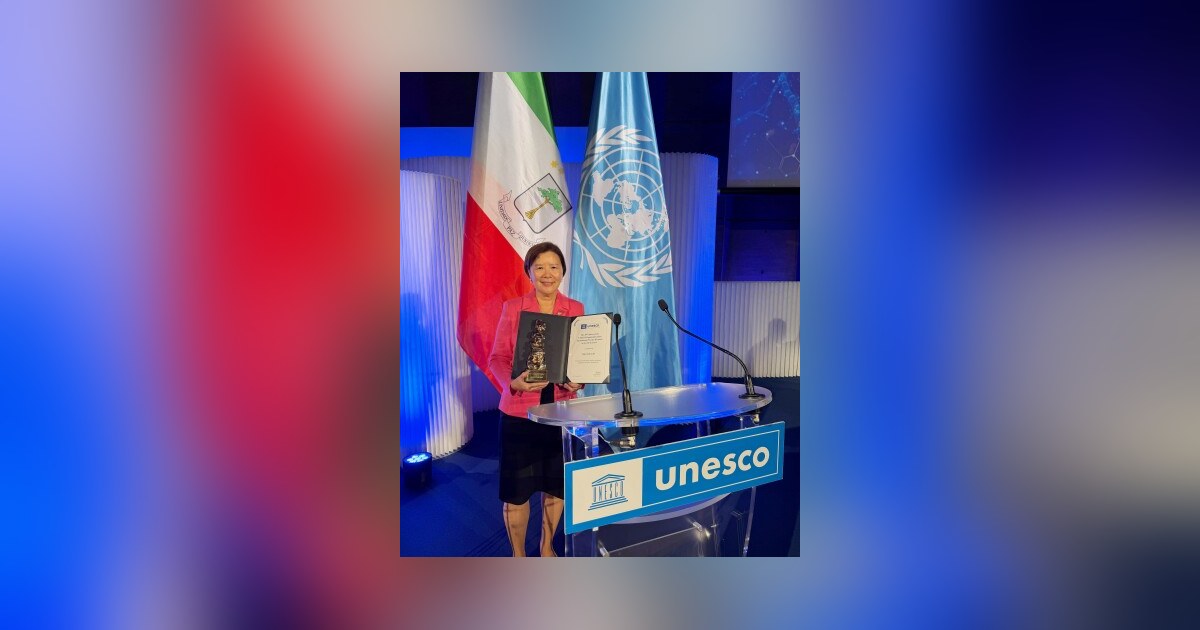
Prof. Nancy Ip, President and The Morningside Professor of Life Science at The Hong Kong University of Science and Technology (HKUST), has been awarded the 2026 UNESCO-Equatorial Guinea International Prize for Research in the Life Sciences for her pioneering work on neuroscience and Alzheimer's disease. The award, announced by Media OutReach Newswire, was presented at a ceremony on November 6 at UNESCO Headquarters in Paris, France.
UNESCO recognized Prof. Ip as an internationally renowned neuroscientist whose research has significantly advanced the understanding of brain function and neurodegenerative diseases. Her team's discoveries include novel biomarkers and genetic risk factors for Alzheimer's, an innovative blood-based diagnostic technology for earlier detection and monitoring, and pioneering advances in gene therapy that open new avenues for prevention and treatment.
The implications of this recognition extend beyond the honor itself. Alzheimer's disease affects millions worldwide, and Prof. Ip's work addresses a critical gap: the historical reliance on data from Western populations, with Asian populations relatively underrepresented. By leading the establishment of a large-scale Chinese Alzheimer's disease biobank—integrating clinical, neuroimaging, and multi-omics data—her team identified multiple genetic risk factors prevalent among Chinese individuals. This provides crucial insights into disease mechanisms and lays the foundation for precision diagnostics and therapeutics tailored to diverse populations.
Prof. Ip's blood-based diagnostic test, noted for its accuracy, minimal invasiveness, and efficiency, has already been adopted by multiple healthcare institutions in Hong Kong and expanded into community settings. This enables earlier detection, timely clinical assessment, and better identification of suitable participants for clinical trials. Such translation from bench to bedside is central to addressing the growing burden of neurodegenerative diseases on healthcare systems and families.
In her remarks, Prof. Ip emphasized the human dimension of the research: "Alzheimer's disease is not just a scientific and medical challenge. It is also a deeply human one, profoundly affecting the lives of those living with the disease and their families." She also stressed the importance of global scientific collaboration and nurturing future researchers, noting that "science is a collective endeavor."
Prof. Ip's career spans more than three decades, with over 350 scholarly papers and 144 patents. Her team is actively exploring novel gene therapy approaches for familial Alzheimer's disease using gene-editing technologies, aiming to build an integrated pipeline from early diagnosis to next-generation therapeutics. This could fundamentally alter the trajectory of neurodegenerative disease management.
The UNESCO-Equatorial Guinea International Prize, established to recognize outstanding scientific achievements that advance human health, this year is shared by three laureates who jointly receive US$300,000 and a statuette. Prof. Ip's award underscores the global relevance of her work and the strength of Hong Kong's research ecosystem, as reflected in the international standing of HKUST. Her achievement signals that Asia-based science is increasingly shaping the fight against Alzheimer's, with tangible benefits for patients and society worldwide.