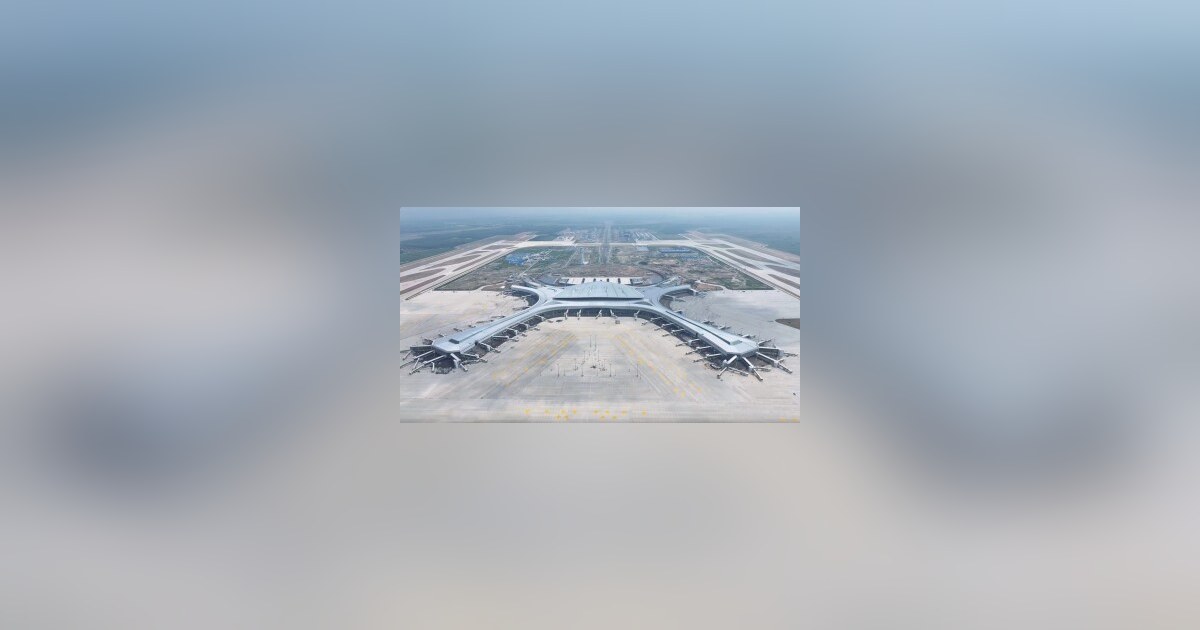
The long-anticipated opening of Hohhot Shengle International Airport on November 26 marks a transformative moment for Inner Mongolia Autonomous Region, as it becomes the region's first 4F-class international airport. Replacing Baita International Airport after 68 years of service, the new hub represents far more than a change of location; it signals a substantial increase in the capacity of Inner Mongolia's air links with the outside world. As reported by Media OutReach Newswire, the airport is designed to handle 28 million passengers, 320,000 tonnes of cargo and mail, and 244,000 aircraft movements annually, positioning it as a key driver of regional economic growth and international engagement.
The infrastructure underpinning this ambition is considerable. Shengle features a terminal building with a floor area of 320,000 square metres and two widely spaced parallel runways, 2,000 metres apart, that can operate independently. Its apron provides 130 aircraft stands. In March 2026, the airport's port-of-entry facilities passed the autonomous region's acceptance inspection, ensuring that customs, immigration and other inspection facilities are fully in place for international operations. The departures hall includes clearly defined areas for international departures, departures to Hong Kong, Macao and Taiwan, and international check-in islands, together with bilingual Chinese–English signage to help passengers navigate their journeys. These features are expected to ease the capacity constraints that have long plagued Baita, which originally planned for 3 million passengers annually by 2015 but has consistently exceeded that limit as Hohhot's economy and cultural tourism sector have grown.
The new airport's route network will build on existing international services. Ahead of the transfer, Hohhot already operates six regular international passenger routes: to Ulaanbaatar in Mongolia; Seoul, Daegu and Busan in South Korea; Vladivostok in Russia; and Bangkok in Thailand via Chongqing. The Ulaanbaatar service is Inner Mongolia's most frequent direct air link between China and Mongolia. From January to July this year, Baita handled 997 inbound and outbound cross-border flights, up 69.9% year on year, and 69,200 cross-border passengers, up 89.3%, reflecting increasingly active cross-border exchanges and cooperation in culture and tourism. Once Shengle opens, the entire existing route network will transfer to the new airport, and Inner Mongolia will use the hub's wider reach to steadily expand international routes to Russia and Mongolia, increase flight frequencies to key domestic regions including the Yangtze River Delta, Guangdong–Hong Kong–Macao, and Chengdu–Chongqing, and improve its network of regional feeder services.
The implications extend beyond aviation. Shengle will serve as a regional aviation hub, one of the main alternate airports for the Beijing–Tianjin–Hebei airport cluster, a national Class I air port of entry, and an important transport node for the Belt and Road Initiative. It will connect with the air networks of China's key economic regions, Northeast Asia and the Russian Far East, while feeder routes will link the grasslands with border ports of entry. Air and overland links will complement each other: Hohhot has launched 22 international transport routes, while its China–Europe and China–Central Asia freight train services reach more than 70 stations in over 10 countries across Europe and Asia. An integrated multimodal transport network supporting international connectivity is rapidly taking shape, which will draw together flows of people, goods, information and capital and drive the development of the airport economy.
For Inner Mongolia, the opening of Shengle is a strategic step in opening up to the north. It will connect with platforms for international trade and cooperation, including pilot free trade zones, China–Europe freight train services and cross-border e-commerce. Wherever its routes reach, cultural and tourism exchanges, trade and industrial cooperation will follow. As the winds rise from the Chilechuan grasslands, the new airport positions Hohhot as a gateway linking China's key economic regions with markets in Northeast Asia and across Eurasia, building closer cooperation through its air routes and embarking on a new journey of openness and shared prosperity.