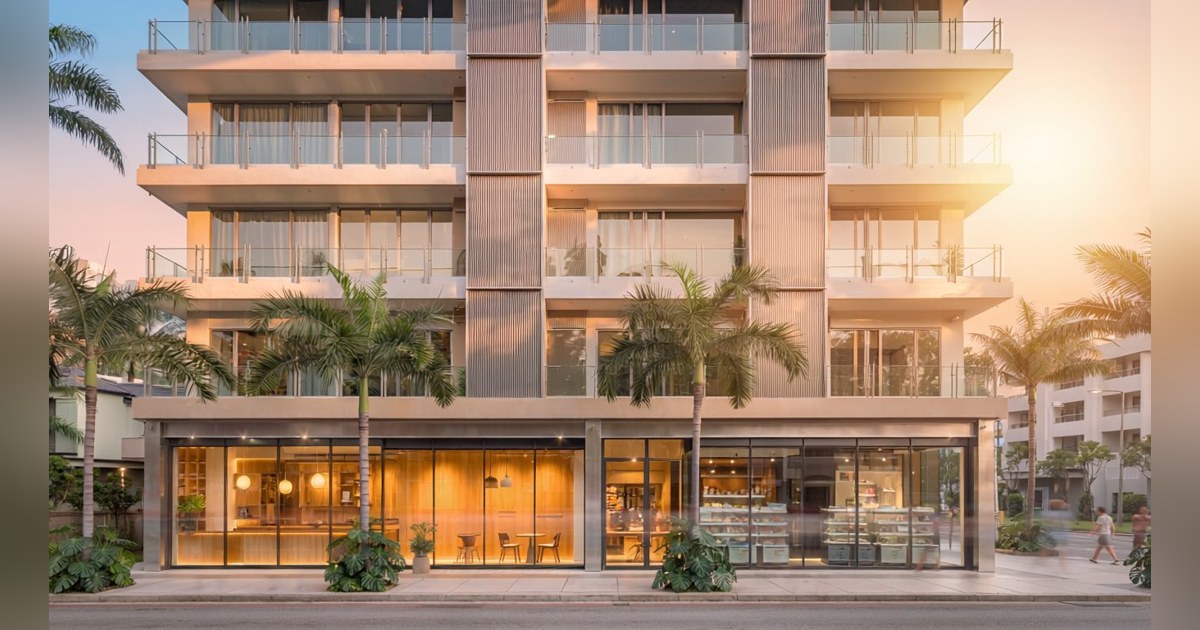
In urban Honolulu, the ground floor of a mixed-use apartment building is often treated as a secondary revenue source, but this approach can significantly undervalue its contribution. According to Erin W.J. Mitsuyoshi, CCIM, of The Bratton Team at Colliers International Hawaii, the commercial component typically generates stronger revenue per square foot than residential units, and it also enhances the overall property value. This dual role means the ground floor warrants separate analysis rather than being lumped into a single residential model.
The direct financial impact is straightforward: retail rents in well-positioned buildings exceed residential rents on the same footprint, giving the ground floor disproportionate weight in net operating income. However, this advantage is location-dependent. The indirect effect is harder to quantify but often larger. A grocery store or café downstairs acts as a building amenity, attracting residential tenants without the operating costs of a gym or roof deck. A well-maintained, visually active street frontage also shapes how the entire building is perceived by prospective residents. At sufficient scale, ground-floor retail can influence neighborhood character, which in turn determines residential demand. Ward Village, a 60-acre master-planned community in urban Honolulu, exemplifies how a deliberately curated street-level offer creates a district identity that draws a particular kind of resident to the apartments above.
Not all tenants succeed under apartments. The most effective are those residents use habitually: daily-needs retail like grocery stores, cafés, laundromats, and services such as medical offices and childcare. A daycare, for instance, is used five days a week by families above, a frequency few retail formats match. The composition varies by neighborhood, often reflecting cultural lines, but the principle remains: convenience is key, and the strongest tenants are those where, as Mitsuyoshi puts it, everybody knows your name.
Underwriting mixed-use properties requires separating the residential and commercial components, modeling each on its own terms before combining them. Expense allocation is critical. Most commercial space in Hawaii is leased on a triple net basis, passing through property taxes, utilities, and building expenses, while residential does not carry those costs the same way. A pro-rata split by square footage misstates both components. Buyers who do the work properly often find commercial income is more durable than assumed. Assets of this type appear regularly across current Hawaii commercial real estate inventory, and recent closed transactions suggest buyers are increasingly pricing the ground floor accordingly.
Tenant selection carries consequences beyond the lease. Incompatible hours, such as a late-night use below apartments, can create friction and slow residential leasing. An operator that struggles can bring arrears, security costs, or parking pressure that spills into residents' stalls—ripple effects that may not appear in a rent roll but eventually show up in the operating statement. Mitsuyoshi notes these are effects most people never see unless they sit on the ownership or property management side, which is why they belong in acquisition diligence.
How much of the ground floor's income the building itself generates depends on use and unit count. With one or two units and convenience retail, residents filter through constantly. A café draws perhaps once or twice a week, a laundromat weekly, childcare five days. A building with several ground-floor units cannot rely on residents alone and must draw from the surrounding neighborhood. That is a solvable design question but changes which tenants make sense. For owners, the useful conclusion is that the street level rewards being underwritten properly. As buyers increasingly recognize this, the ground floor is no longer a supplementary line but a key driver of value.