Huawei's relentless focus on research and development has produced a series of technological breakthroughs that could reshape its competitive position in the global technology landscape. At an international media roundtable in Shenzhen, Richard Yu, Executive Director and Chairman of the Investment Review Board, detailed how the company's massive R&D spending has enabled it to overcome supply chain restrictions and build a self-sufficient technology stack.
Between 2007 and 2025, Huawei invested more than CNY1.8 trillion (approximately $250 billion) in R&D, with the annual budget rising from about 10% of revenue in early years to over 20% recently. This sustained investment has translated into robust core capabilities, extensive intellectual property, and a vast patent portfolio. The payoff is evident in the new Mate 90 series smartphones, which feature the Kirin 9050 Pro chip. The device's overall performance is 31% higher than the previous generation, and it runs a 30-billion-parameter on-device AI model. Notably, all key components—the Balong modem, image sensor processor, mobile security processor, Lingxi CPU, Maleoon GPU, and the Da Vinci architecture NPU—are designed by Huawei.
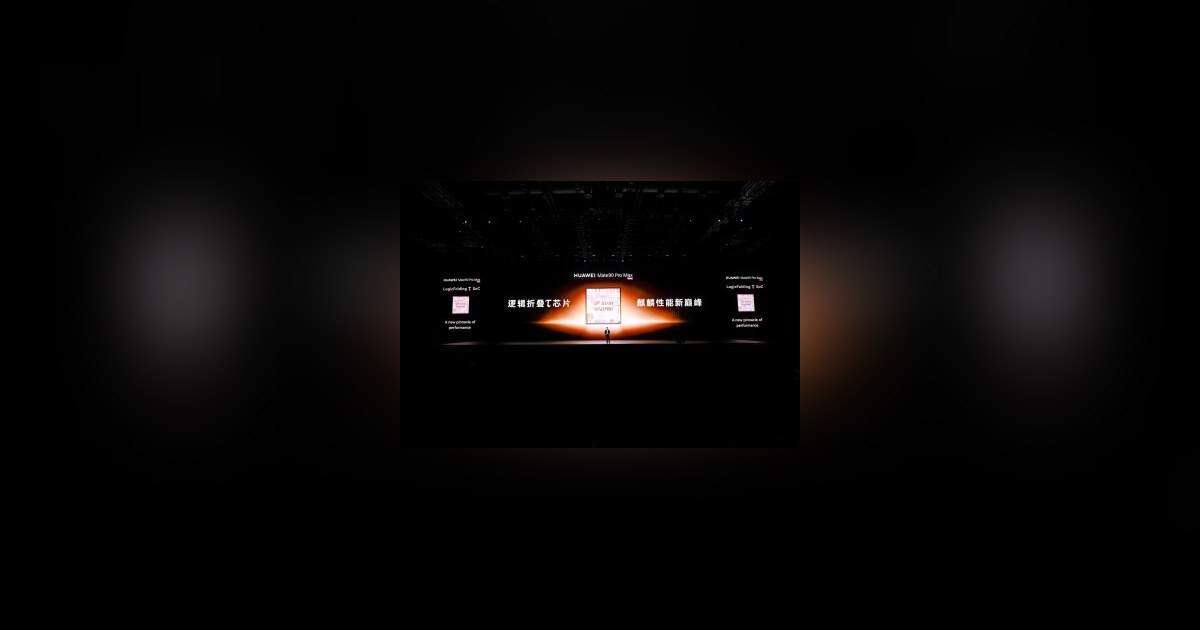
A key breakthrough is the LogicFolding technology under the Tau Scaling Law, unveiled by He Tingbo, head of Huawei's Semiconductor Business Department, this May. This technology vertically stacks logic layers of chips and restructures circuit layout through inter-layer high-density interconnect to shorten critical paths and reduce latency. Adopted on the Kirin 9050 Pro, it demonstrates strong AI processing power. Yu confirmed that more phones will use LogicFolding chips in the future, despite admitting that Huawei has limited access to advanced semiconductor processes and that production capacity for advanced semiconductors in China cannot yet meet rapidly growing demand.
Beyond hardware, Huawei's HarmonyOS ecosystem has reached critical mass. More than 90 million devices now run HarmonyOS 6 and HarmonyOS 7, a figure expected to hit 100 million by the end of the year. The ecosystem boasts over 450,000 apps and services, 11 million registered developers globally, and more than 23,000 app innovation partners. Yu expressed special thanks to partners and developers and revealed that Huawei is considering gradually bringing HarmonyOS to the global market.
Huawei's strategy spans five key scenarios: HIMA-powered Smart Travel, HarmonyOS Office, Smart Home, Fitness & Health, and Entertainment. The company offers a broad range of products, including smartphones, PCs, tablets, wearables, TWS audio products, smart TVs, home routers, and intelligent electric vehicles with partners. Underlying these is Huawei's chip hardware platform and HarmonyOS, which stands as the third major operating system ecosystem after Apple's iOS and Google's Android.
In the AI domain, Huawei provides the Ascend compute foundation, large models called openPangu, AI capabilities for intelligent driving, and HarmonyOS Celia. The company is also using AI to improve operations and maintenance of communications network equipment. By combining AI computing power with domestic open-source large models, Huawei aims to help enterprises and industries worldwide become more productive.
Yu also addressed globalization. He noted that Huawei had strong collaborations with companies from the US, Europe, Japan, South Korea, and Taiwan, delivering significant business value. Since 2019, Huawei has gradually designed its own operating system and developed basic tools and software, putting a domestic supply chain in place. In 2023, it resumed domestic manufacturing of smartphone chips. With these chips and HarmonyOS, relying on China's domestic supply chain, materials, and process nodes, Huawei has basically eliminated its dependence on US technologies.
While Huawei's global smartphone market share was once No. 1, it now sells only several million units outside China annually. Yu revealed that Huawei is trying to return to overseas markets step by step. In wearables, Huawei is No. 1 in market share both in China and globally. TWS earphones are growing fast and have reached No. 1 in many countries. HarmonyOS-based tablets are performing strongly, and CPE mobile routers are well received in many regions outside China, helping connect remote and rural areas.
For a full Q&A session, see https://www.apmultimedianewsroom.com/multimedia-newsroom/continuous-innovation-securing-our-competitive-edge-through-technological-breakthroughs. This announcement matters because it signals Huawei's ability to innovate under pressure, potentially intensifying competition in the global smartphone and AI markets. As the company ramps up production and expands HarmonyOS globally, it could challenge the dominance of established tech giants and reshape supply chains worldwide.