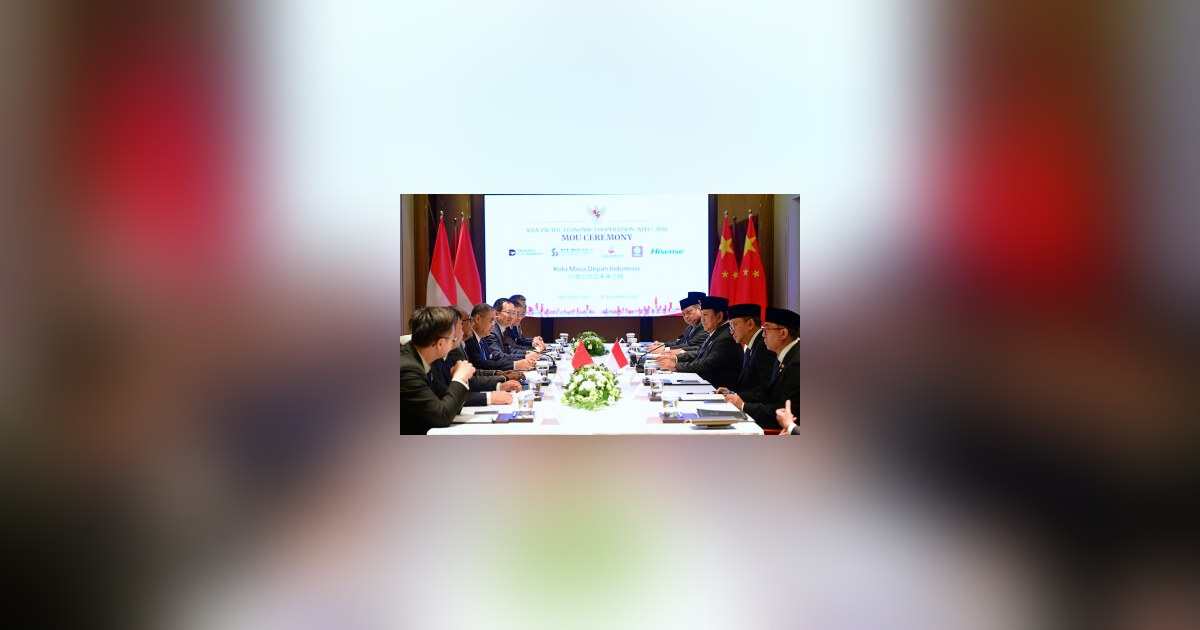
Indonesia and Chinese companies and institutions have set out four areas of cooperation with a combined indicative value of USD 63 billion during APEC Economic Leaders' Week in Shenzhen, according to a press release distributed via Media OutReach Newswire. The agreements, witnessed by President Prabowo Subianto, cover smart cities, home-appliance manufacturing, coal-to-ethanol fuel production, and a proposed renminbi financing framework. The scale of the commitments matters because it aligns Chinese capital, engineering, and process technology with Indonesia's decade-long priorities: housing, industrial capacity, energy independence, and supporting infrastructure.
The largest initiative is a smart-city programme valued at USD 50 billion. PT Kota Masa Depan Indonesia, a project entity 99% owned by PT Danantara Asset Management, signed a non-binding memorandum with a consortium led by Shaanxi Construction Engineering Group, including Hisense and other Chinese companies. The plan envisages 10 cities at an indicative USD 5 billion each, with approximately 1.5 million housing units and supporting infrastructure for about 3 million residents. Each city is designed as complete neighbourhoods with schools, hospitals, places of worship, markets, parks, and municipal service centres, alongside utilities and digital systems such as water treatment, flood protection, solar power distribution, fibre networks, and command centres for traffic and utilities. The consortium expects delivery over three to five years, subject to procurement processes.
A proposed renminbi financing framework of up to USD 10 billion equivalent could support infrastructure projects and also be applied to the smart-city programme, meaning up to USD 10 billion of the total may overlap. Three Chinese financial institutions—Changjiang Securities International, Shanghai Pudong Development Bank Hong Kong Branch, and SDIC Securities (Hong Kong)—held discussions with PT Danantara Asset Management on 17 November. The framework would be assembled through USD 5 billion equivalent in panda bonds in mainland China and USD 5 billion equivalent in dim sum bonds in Hong Kong, deployed in stages. Target sectors include power generation and grid modernisation, renewable energy and storage, downstream mineral processing, advanced manufacturing, digital infrastructure and data centres, transport and logistics, and healthcare. The institutions noted that participation does not indicate irrevocable commitment of funds.
In manufacturing, Hisense signed a memorandum advancing an investment programme with an indicative value of USD 1 billion, including plans for its largest home-appliance manufacturing facility outside China. The company will increase manufacturing investment in step with demand from Indonesia's Koperasi Merah Putih programme, which aims to establish around 80,000 village and urban cooperatives. Hisense and Institut Teknologi Bandung are also establishing a company-funded laboratory to support the household transition from gas to electricity and to develop energy-efficient appliances suited to Indonesian homes.
Beijing Petrochemical Engineering signed a memorandum with Badan Industri Mineral on coal-to-ethanol cooperation valued at USD 2 billion. The initiative aims to convert Indonesia's low-grade coal into ethanol for transport fuel, with production and refining based in Indonesia for the domestic market. Producing ethanol at home would reduce dependence on imported fuel, add value to a resource Indonesia holds in abundance, create skilled industrial jobs, and retain more energy spending within the economy. BPE's coal-to-ethanol process package was developed jointly with the Dalian Institute of Chemical Physics, Chinese Academy of Sciences.
Taken together, the announcements signal that Chinese institutions are prepared to commit significant resources to Indonesia's long-term development agenda. The involvement of three established Chinese financial institutions in a renminbi-based framework reflects institutional interest in Indonesia's economic direction. For Indonesia, the deals could accelerate housing and urban development, deepen industrial capacity, and advance energy security, while for China they represent a deepening of economic ties across the Asia-Pacific.