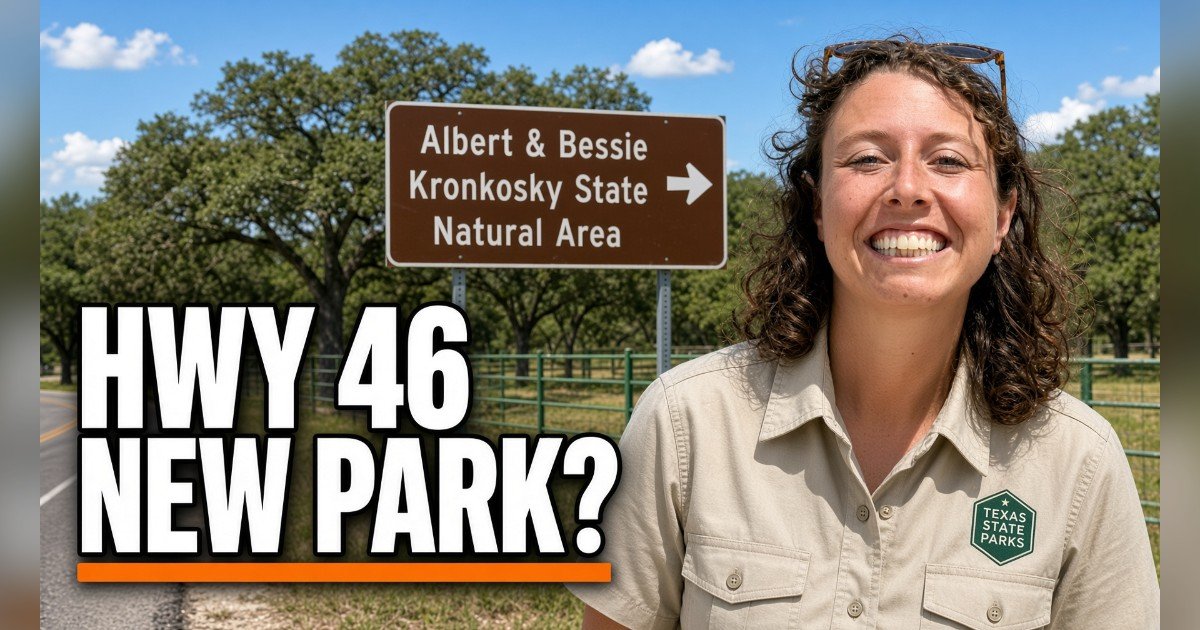
The Albert and Bessie Kronkosky State Natural Area, a 3,814-acre tract straddling Bandera and Kendall counties along Highway 46, is being prepared for a late fall 2026 public opening, according to the latest episode of The Building Texas Show. The site’s new superintendent, Stephanie Kwiatkowski, who took the role in June, explained to host Justin McKenzie why Texas Parks and Wildlife has classified the property as a state natural area rather than a state park—a distinction with legal and operational consequences under the Texas Administrative Code.
Kwiatkowski described the difference as a spectrum between recreation and conservation, comparing ABK to sites such as Government Canyon, Lost Maples, Inks Lake, and McKinney Falls. The natural-area designation places greater emphasis on protecting the landscape than on maximizing visitor amenities, and the episode’s detailed discussion of that trade-off is central to understanding what the opening will mean for the region. As development pressure increases across the Hill Country, ABK represents a deliberate choice to safeguard a large, ecologically sensitive property while still allowing public access.
The site will offer 28 miles of multi-use trails open to hikers, mountain bikers, joggers, and strollers, along with cabins, screened shelters, tent sites, backcountry camping, and hike-and-bike infrastructure now being readied by construction crews, subcontractors, and a six-person site team. The ecological specifics justify the protective designation: bigtooth maples that rival those at Lost Maples State Natural Area, riparian corridors along Red Bluff Creek and Pipe Creek, and transition zones between ash juniper woodlands and creek bottoms. Kwiatkowski also highlighted the protected viewshed, recalling a moment during her first weeks on site: “The site owns both sides of those canyons. And so that view, that viewshed, it is safeguarded for, um, forever.”
The superintendent’s comments come after a July 2026 flooding event that washed out landscaping, trails, and campsites before any public visitation, providing operational lessons that are informing preparations. Kwiatkowski credited the volunteer corps assembled by founding superintendent James Rice, a former biologist, calling the relationships “integral to our success as a site.” The episode is a return visit for the show, which previously hosted Rice while the land was still in survey and planning; the earlier conversation is available in the episode New Texas State Park Near Boerne: Why It Isn't a Park | ABK.
The implications extend beyond a single recreation destination. ABK’s opening will add a significant public land holding between two fast-growing Hill Country communities, and its natural-area model may serve as a test case for how Texas balances access with preservation as private land fragments. Kwiatkowski’s path—from childhood camping to an environmental science degree, GIS and consulting work, a seasonal job with the City of New Braunfels parks, a park operations trainee role at the Lost Pines Complex, and an assistant superintendent stint at Pedernales Falls State Park—illustrates the operational experience guiding the site through its final preparations.