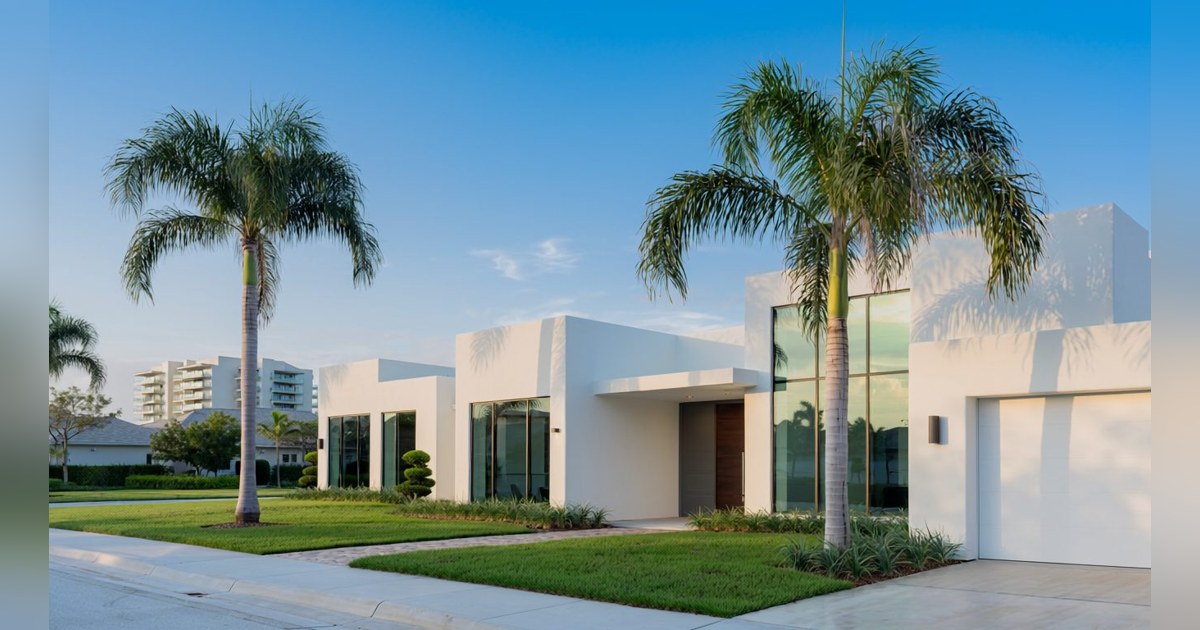
The Palm Beach County housing market is not crashing but splitting into two distinct markets, according to real estate agent Loodmy Jacques of The Jacques Team at Keller Williams Reserve in West Palm Beach. Single-family homes remain in seller's territory, while condos have tipped toward buyers, creating a divergence that carries significant implications for buyers, sellers, and the broader real estate landscape.
Supply and speed metrics reveal the gap. Single-family homes have roughly 3.5 months of supply, a level associated with a seller's market, while condos sit closer to 6.7 months. The median single-family home goes under contract in about 40 days, compared with about 69 for condos. Single-family homes typically close near 95 percent of their original list price, against roughly 93 percent for condos. That extra month on the market matters because each additional week tends to invite lower offers. Multiple offers still occur on well-priced houses but are uncommon on condos unless the building is newer or fully funded. Condo prices have not collapsed; Jacques puts the median condo price up about 5 percent year over year.
The pressure on older condos traces largely to reforms Florida adopted after the 2021 Surfside collapse. Buildings three stories or taller must now complete a Structural Integrity Reserve Study and set money aside for the repairs it identifies. "Owners in older buildings are now paying for decades of delayed repairs all at once," Jacques says. That cost arrives as higher monthly dues, special assessments, or both. Financing has tightened alongside it. Jacques estimates that only about 21 of roughly 2,400 South Florida condo buildings are approved for FHA loans, and more than half of condo purchases in Palm Beach County are now paid in cash.
On the single-family side, the problem is the opposite: tight inventory. Many owners holding low-rate mortgages are staying put, and Jacques estimates the county has about 24 percent fewer single-family homes available than a year ago. Buyer preference is shifting toward owning land without association rules and toward simpler financing. That does not mean a return to 2021. Buyers remain price-sensitive, and homes priced in line with the market tend to move quickly while those that are not can sit.
The county-wide condo median can mislead, as a headline showing condo prices up 5 percent blends newer, well-funded buildings with older ones that may be flat or declining. For an individual unit, Jacques says, the building's reserve study and financial health matter more to price than the county median does. That makes the buyer's side of the process increasingly about documents rather than square footage. As Jacques puts it, condos "are a building-by-building decision."
For consumers, the divergence means that strategies must differ by property type. Condo buyers may have more negotiating power, but they must scrutinize building finances and reserve studies. Single-family buyers face competition and limited inventory, especially for move-in-ready homes. Sellers of single-family homes still have an edge if priced correctly, while condo sellers in older buildings may need to adjust expectations. Jacques, who has 17 years of experience and works in English, French, and Spanish, provides detailed insights on his website at Loodmy Jacques.
The county's housing story heading into the fall is less about direction than divergence. Single-family homes are being priced against a shortage, while condos are a building-by-building decision. This split is likely to persist as long as inventory remains tight and condo reforms continue to reshape the market.