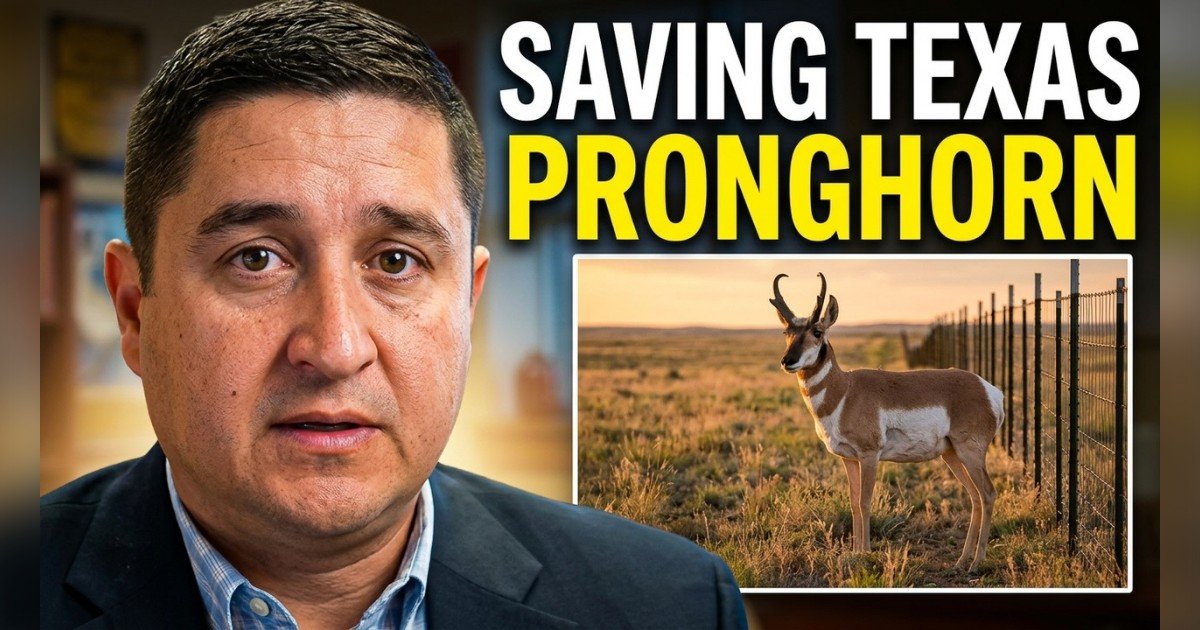
The near-collapse and subsequent rebound of the West Texas pronghorn population, alongside the return of New World screwworm to Texas after decades of eradication, are the focus of a recent episode of the Building Texas Show. Host Justin McKenzie traveled to Alpine to speak with Lalo Gonzalez, chair of the Department of Natural Sciences at Sul Ross State University and a leader at the Borderlands Research Institute (BRI). The conversation provides a timely dispatch from a fragile, rapidly changing landscape, revealing why these intertwined stories matter for the future of the region.
Gonzalez detailed the 2010-2011 Texas Parks and Wildlife translocation program that moved roughly 1,000 pronghorn from the Panhandle to the Marfa and Marathon grasslands, a key step in the species' recovery. He explained that pronghorn are uniquely vulnerable to fencing and brush encroachment because they behave nothing like whitetail deer. "They don't jump fences. They physically can't. They just seem to not like doing it. So any fence is a barrier, pretty much. It's a wall that they don't cross," Gonzalez said. He credited landowners like Nile Maxwell for opening gates, removing historic fencing, and lowering bottom wires to about 18 inches so pronghorn can slip underneath without disrupting livestock operations. In a state that is 95% privately owned, Gonzalez called private stewards "the best conservationists."
The episode also examined the return of New World screwworm, a flesh-eating fly larva that the U.S. pushed south to Panama in the 1960s using sterile-fly technology. Gonzalez noted recent positive cases in Texas livestock and confirmed wildlife cases in northern Mexico that cross the border freely, even as cattle imports have been paused. The implications are significant: screwworm poses a direct threat to livestock and wildlife, and its reemergence signals gaps in eradication efforts. Gonzalez connected the dots to other emerging threats, including the first-ever pneumonia outbreaks in Texas desert bighorn sheep—Texas had been the last holdout state—alongside ongoing work on scaled quail, black bears, mule deer, sandhill cranes, soil health, and hydrology. Drought comparable to Death Valley in some years and the steady loss of working landscapes from El Paso to Del Rio further complicate conservation efforts.
BRI's graduate program, Gonzalez added, boasts a 95% job-placement rate at graduation, with millions of acres of West Texas serving as the classroom. That detail underscores the practical, place-based approach to research and education that BRI champions. For listeners, the episode offers a working tour of BRI's research portfolio and the pressures reshaping the Trans-Pecos. The The Building Texas Show tells the stories of the founders, community leaders, and projects shaping Texas, from economic development and small business to conservation and education. New episodes publish weekly on YouTube and all major podcast platforms. The pronghorn and screwworm stories are not just about wildlife; they are about land use, private stewardship, and the resilience of a region where economic and ecological futures are tightly bound together.