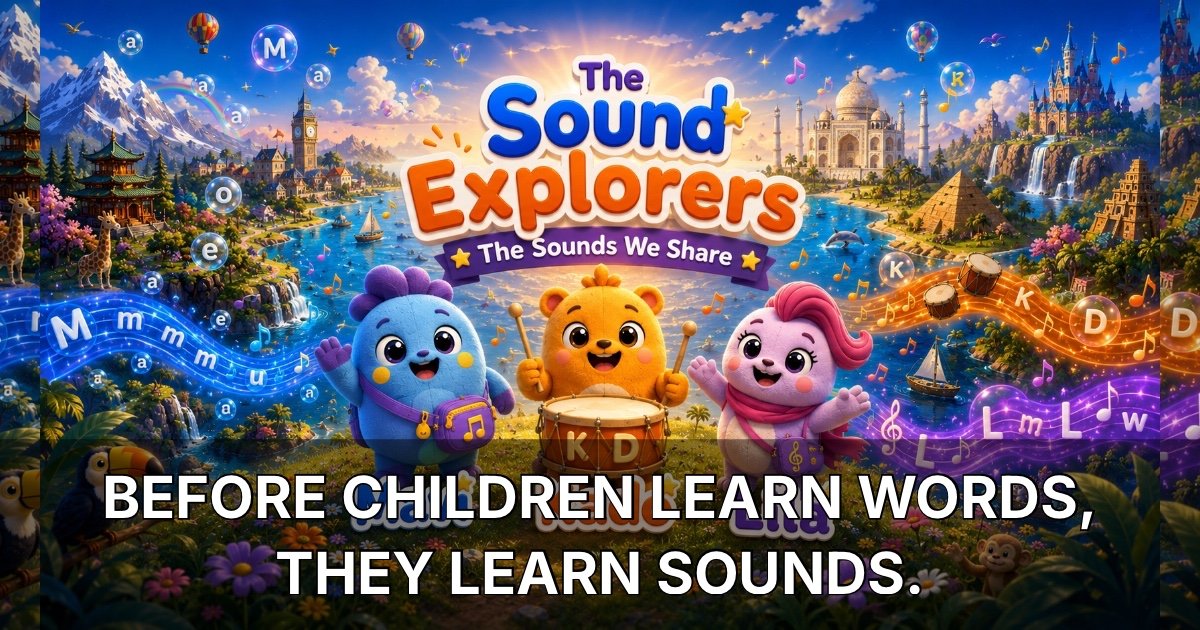
The Sounds We Share, a children's music channel that creates songs using only universal speech sounds instead of words, has launched at thesoundsweshare.com and on YouTube. The channel aims to erase language barriers, allowing every child to hear the same song the same way without dubbing or translation.
Founder Bryan Eisenberg, a former educator and social worker turned digital marketing pioneer and New York Times bestselling author, conceived the idea 15 years ago after learning about phonemes—the universal building blocks of spoken language—at Wizard Academy in Austin, Texas. "Before children learn words, they learn sounds," Eisenberg said. "Words sometimes divide us. The sounds underneath them belong to everyone."
The channel's songs are composed from hums, pops, rolls, and whooshes that humans universally use to speak. This approach aligns with research showing that babies are born able to hear the full range of human speech sounds, but their brains begin specializing in the sounds of their home language during the first year—a process called perceptual narrowing. The Sounds We Share builds songs inside that early window, pairing each song with a simple movement like bounce, march, or twirl that families can do together.
The channel is deliberate about its claims: it does not assert that its songs will make a child bilingual or smarter. Instead, it promises playful early sound exposure, listening, imitation, movement, and music that children enjoy replaying. The songs live in a world of magical Sound Lands explored by three characters: Mavi (the blue Sound Explorer), Kado (the orange Rhythm Explorer), and Lila (the lavender Melody Explorer). Season One launches in two collections: Sound Adventures for daytime energy and Dream Sounds for gentle lullabies incorporating rain and ocean waves.
The music and animation are produced with AI tools including Suno and Gemini, then shaped by human judgment. Every song must pass a test: would a child ask to hear it again, and would a parent survive the tenth replay? The channel openly discloses its use of AI on its website. "Families deserve two things kids' media rarely gives them: honesty about how the content is made and honesty about what it can do," Eisenberg said. "We put both on the front page."
The channel targets children ages 0 to 5 and their families, offering a free Family Movement Guide printable at thesoundsweshare.com. Based in Round Rock, Texas, the project is an independent family effort that Eisenberg describes as a dream to share with his grandchildren. The importance of this announcement lies in its potential to provide a universally accessible, inclusive musical experience for young children, fostering early sound awareness without cultural or linguistic barriers.