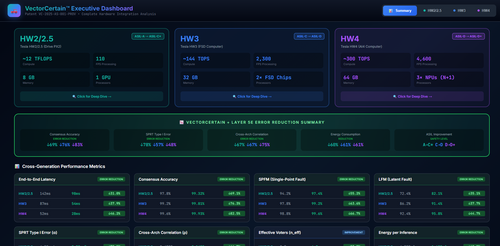
VectorCertain LLC today announced the commercial availability of its Micro-Recursive Model with Cascading Fusion System (MRM-CFS), a breakthrough architecture designed to extend AI safety coverage into the statistical tails where rare but catastrophic events occur. As AI systems increasingly control life-and-death decisions in autonomous vehicles, medical diagnostics, and financial markets, traditional AI models consistently fail on these edge cases, undermining their reliability.
MRM-CFS deploys ensembles of ultra-compact models as small as 71 bytes each. These Micro-Recursive Models work together through a cascading fusion system to detect and correct anomalies that larger, monolithic models typically overlook. According to VectorCertain, this approach enables precise detection and fusion solutions for rare, high-impact scenarios that conventional AI systems cannot handle.
"Existing AI systems fail on rare events; MRM-CFS offers precise detection and fusion solutions," the company stated in a press release. By focusing on these statistical outliers, the architecture aims to prevent catastrophic outcomes in mission-critical applications where safety is paramount.
The technology is designed for embedded, legacy, and regulated environments requiring low latency, fault tolerance, and auditable human oversight. VectorCertain, a Delaware corporation headquartered in Maine, specializes in AI safety for mission-critical systems. The company develops micro-recursive model architectures that extend safety coverage into rare, high-impact edge cases.
For more information, view the full announcement, including downloadable images and bios, here. The press release was distributed by Reportable, Inc.