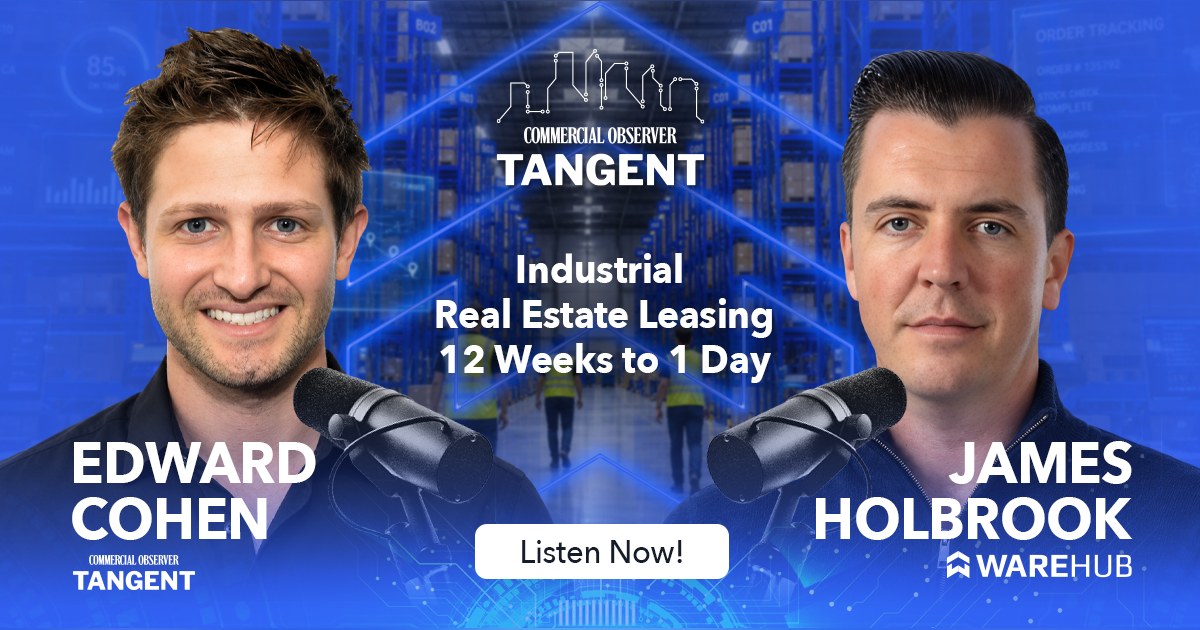
James Holbrook, Founder and Executive Chairman of Warehub, appeared on Commercial Observer's Tangent podcast with host Edward Cohen to discuss how industrial leasing can better serve the changing needs of modern logistics. The conversation centered on a connected digital process that could help businesses secure warehouse space faster, give landlords more opportunities to generate income from vacancy, and allow brokers to spend more time advising clients. The implications of this discussion are significant for an industry where speed and flexibility are increasingly critical.
At the heart of the announcement is a striking claim: Warehub can reduce the process from receiving a tenant requirement to executing a lease from a typical 12 weeks to just one day. This compression represents a potential paradigm shift. In an era of supply chain disruptions and e-commerce demands, the ability to secure industrial space in days rather than months could become a competitive advantage for tenants and a revenue accelerator for landlords. For brokers, it means less time on paperwork and more time on high-value advisory work.
Warehub's platform is designed to connect demand, inventory, and execution through a single intelligent system. By standardizing property data, digitizing leasing workflows, and coordinating the participants required to activate industrial space, Warehub enables landlords, tenants, and brokers to move from requirement to occupancy with greater speed, transparency, and efficiency. According to the announcement, Warehub has onboarded more than 52 million square feet across approximately 40 U.S. markets, with more than 200 users and 368 suites. These metrics suggest that the platform is gaining traction, though the broader impact will depend on how widely the industry adopts such digital tools.
The podcast conversation also highlighted the benefits for all parties: tenants, landlords, brokers, and service providers can discover space, coordinate terms, execute standardized lease documents, and manage the activities needed to begin and support occupancy. This holistic approach could reduce friction and accelerate payment cycles, as encapsulated in Warehub's tagline: "More deals. Less friction. Faster payment." For an industry that has traditionally relied on manual processes and fragmented communication, the move toward a unified digital operating system could be transformative.
To view the full announcement, including downloadable images and bios, click here. For more information, visit Warehub.com. The source of this announcement is WAREHUB, distributed by Reportable, Inc.
Why does this matter? Industrial real estate is a cornerstone of the U.S. economy, supporting everything from manufacturing to last-mile delivery. A 12-week leasing process is a bottleneck that can delay business expansion, increase costs, and leave valuable space underutilized. By demonstrating that this timeline can be compressed to a single day, Warehub is challenging the status quo. If adopted at scale, this could lead to more dynamic industrial markets, where space is activated quickly and efficiently. Landlords could see reduced vacancy periods, and tenants could respond to market changes in real time. Brokers could shift from administrative tasks to strategic consulting, enhancing their value proposition.
However, the success of this vision depends on industry-wide adoption of standardized data and digital workflows. Warehub's growing footprint—52 million square feet across 40 markets—indicates that some players are already embracing the model. The podcast appearance itself, on a platform like Commercial Observer's Tangent, signals that the conversation is reaching influential audiences. As logistics continues to evolve, the pressure to modernize leasing processes will only intensify. Warehub's approach offers a glimpse of a faster, more flexible future—one where the time from requirement to occupancy is measured in hours, not weeks.