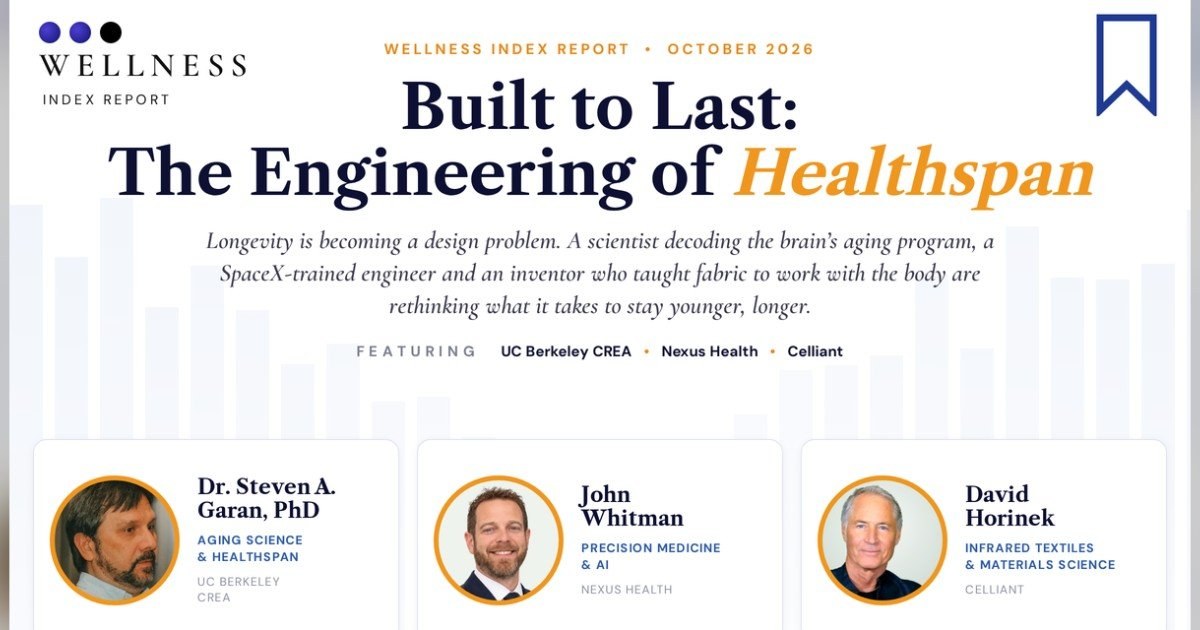
The October 2026 issue of the Wellness Index Report, titled 'Built to Last: The Engineering of Healthspan,' marks a significant shift in the longevity conversation: from hoping for a longer, healthier life to actively engineering one. Released by Wellness Eternal, the report profiles three experts from The Wellness Index Report Podcast who are each tackling a different facet of the aging process, and their work signals how healthspan is becoming a measurable, designable target rather than a matter of chance.
Central to the report is Dr. Steven A. Garan's proposition that aging is a brain-governed program that accelerates in midlife and menopause. This framing matters because it reframes aging as a biological process that might be interrupted or slowed, not an inevitable decline. The report's release coincides with World Menopause Day, underscoring the timeliness of addressing midlife transitions as a critical window for healthspan interventions. If aging is indeed orchestrated by the brain, then therapies targeting neural regulation could have broad implications for how quickly or slowly the body deteriorates.
The second trend involves John Whitman and Nexus Health, who are advancing clinician-reviewed, privacy-focused precision health AI. Their approach connects genetics, lab results, and personal history to deliver explainable findings under clinician control. This is important because it addresses two barriers to adoption: trust in AI recommendations and the need for interpretable insights that doctors can act on. By keeping clinicians in the loop and prioritizing privacy, Nexus Health exemplifies how AI can be integrated into personalized longevity care without sacrificing safety or transparency.
David Horinek's work with Celliant infrared textile technology represents the third trend: embedding wellness into everyday products like sleepwear, bedding, and recovery apparel. This matters because it moves healthspan support out of the clinic and into daily life, potentially improving sleep and recovery without requiring active effort from users. If such technologies prove effective, they could become passive tools for extending healthspan, accessible to a broad population.
Together, these three builders of healthspan illustrate a broader movement: aging is being re-engineered through neuroscience, artificial intelligence, and materials science. The report's focus on these areas suggests that the future of longevity may lie not in a single breakthrough but in the convergence of multiple disciplines. For readers interested in the full announcement, including downloadable images and bios, click here. The monthly Wellness Index Report continues to highlight the people and ideas shaping biohacking and longevity, and this issue makes clear that the engineering of healthspan is no longer a speculative concept but an emerging reality with tangible implications for how we age.