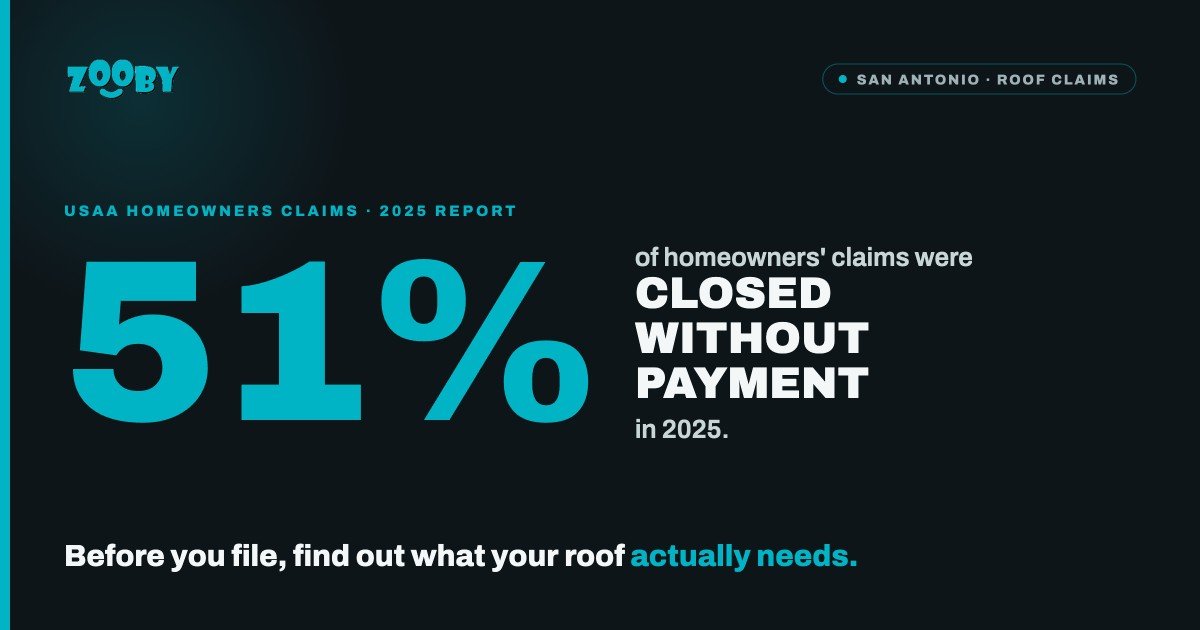
Recent reporting found that approximately 51% of homeowners' claims handled by USAA and affiliated insurers closed without payment in 2025. That figure does not mean USAA wrongfully denied half of its homeowners' claims. Claims may close without payment because the approved damage falls below the deductible, the policy excludes the loss, the homeowner decides not to continue the claim, related claims are combined, or a closed claim is later reopened. USAA has said that after accounting for those circumstances, fewer than 6% of its homeowners claims were denied without payment.
Zooby Home Exteriors explains the distinction and its practical effect on homeowners in “USAA Closed 51% of Homeowners’ Claims Without Payment. Before You File, Find Out What Your Roof Actually Needs.” The figures arrive as hail damage is receiving renewed national attention. A July 2026 New York Times report, “Inside the United States’ Billion-Dollar Blind Spot,” examined the growing cost of hail and why the threat remains difficult to measure and predict. For San Antonio homeowners, the two stories point to the same concern: storm damage can become a household financial problem, especially when repair costs approach or fall below a percentage-based wind or hail deductible.
After a hailstorm, homeowners may notice loose shingles, granules in the gutters, damaged vents, ceiling stains, or signs of roofing damage throughout the neighborhood. Those signs deserve attention, but they do not reveal the roof's full condition. A professional inspection can help identify visible hail or wind damage, lifted or missing shingles, granule loss, damaged flashing, cracked pipe boots, water intrusion, age-related deterioration, and isolated problems that may be repairable. Zooby discusses these roof stressors in “What’s Damaging Your Roof? A San Antonio Homeowner’s Guide to Inspection, Repair, and Zoobification.”
The inspection answers a roofing question: what does the roof actually need? The insurance carrier answers a different question: what does the policy cover? Zooby can inspect the roof and document visible conditions. Zooby does not determine whether an insurance company must pay a claim.
Many Texas homeowners policies use percentage-based wind and hail deductibles. For a home insured for $350,000, a 2% wind or hail deductible equals $7,000. If an insurance carrier approves $6,500 in covered roof repairs, the homeowner may receive no payment because the approved amount is lower than the $7,000 deductible. The Texas Department of Insurance provides a similar example in its consumer guidance. Zooby provides a more detailed explanation in “Wind and Hail Deductibles in Texas: Why Your Roof Claim May Cost More Than You Expect.”
“The percentage on the declarations page can look small,” Zubiate said. “Once it is converted into dollars, the homeowner may discover that the deductible is several thousand dollars. That number can completely change the claim decision.” Zooby is encouraging San Antonio homeowners to calculate their wind and hail deductible in dollars before storm damage creates pressure to act quickly.
Hail is one of the most expensive severe weather threats in the United States. The Insurance Institute for Business & Home Safety reports that annual hail losses routinely exceed $10 billion. “Hail is not only a roofing issue. It can become a household financial issue,” Zubiate said. “A homeowner may know they have insurance but not realize how large the deductible could be until after the storm.” Zooby examines this in “The $7,000 Hail Surprise: What San Antonio Homeowners Should Know Before the Next Storm.”
Some homeowners assume storm damage means the entire roof must be replaced. That is not always true. Limited damage may be corrected by replacing damaged shingles, repairing flashing, addressing a leak, or completing another targeted roof repair. Other roofs may have widespread storm damage, advanced deterioration, or structural concerns that make roof replacement the responsible option. “Before a homeowner creates a claim record or commits to replacing the roof, they should know whether the problem can be repaired,” Zubiate said. “That information can prevent an expensive decision based on fear or assumptions.”
The deductible is not the only part of a homeowners policy that may affect a roof claim. Zooby recommends that homeowners review the wind and hail deductible, replacement cost or actual cash value terms, roof age limitations, depreciation requirements, cosmetic damage exclusions, matching provisions, and any wind or hail exclusions. The Texas Department of Insurance home insurance guide explains that claim payments may be reduced by depreciation and the deductible, depending on the coverage.
Zooby is not advising homeowners to avoid legitimate insurance claims. However, Zooby encourages homeowners to understand the roof condition, the likely repair cost, and the deductible before automatically filing. After inspection, the appropriate option may be repair, Zoobification, or full roof replacement. Zoobification is Zooby’s service for qualifying asphalt shingle roofs that are aging but still have useful life. Zooby also provides a Limited Credit Warranty for Zoobification, subject to written warranty terms.
Zooby reminds homeowners that a Texas roofing contractor cannot legally waive, absorb, rebate, or help a homeowner avoid paying an insurance deductible. The Texas Department of Insurance warns consumers that deductible-waiver offers may involve rebates, inflated invoices, or other arrangements intended to make the deductible disappear.